If you run a small business in India, you already know the feeling. You spend hours answering the same WhatsApp messages, following up with leads who never respond, updating customer records, preparing quotations, and trying to remember appointments. By the time you finish the administrative work, there's little energy left for actually growing the business.
This is exactly where AI automation comes in. Not as a replacement for your team, but as a way to handle repetitive workflows so you and your employees can focus on customers and revenue-generating activities.
What's the difference between AI and automation? Traditional automation follows predefined rules—like sending an email when a form is submitted. AI goes further: it can understand text, classify information, generate responses, summarize conversations, and assist with decisions. When you combine both, you get AI-powered workflows that actually feel intelligent.
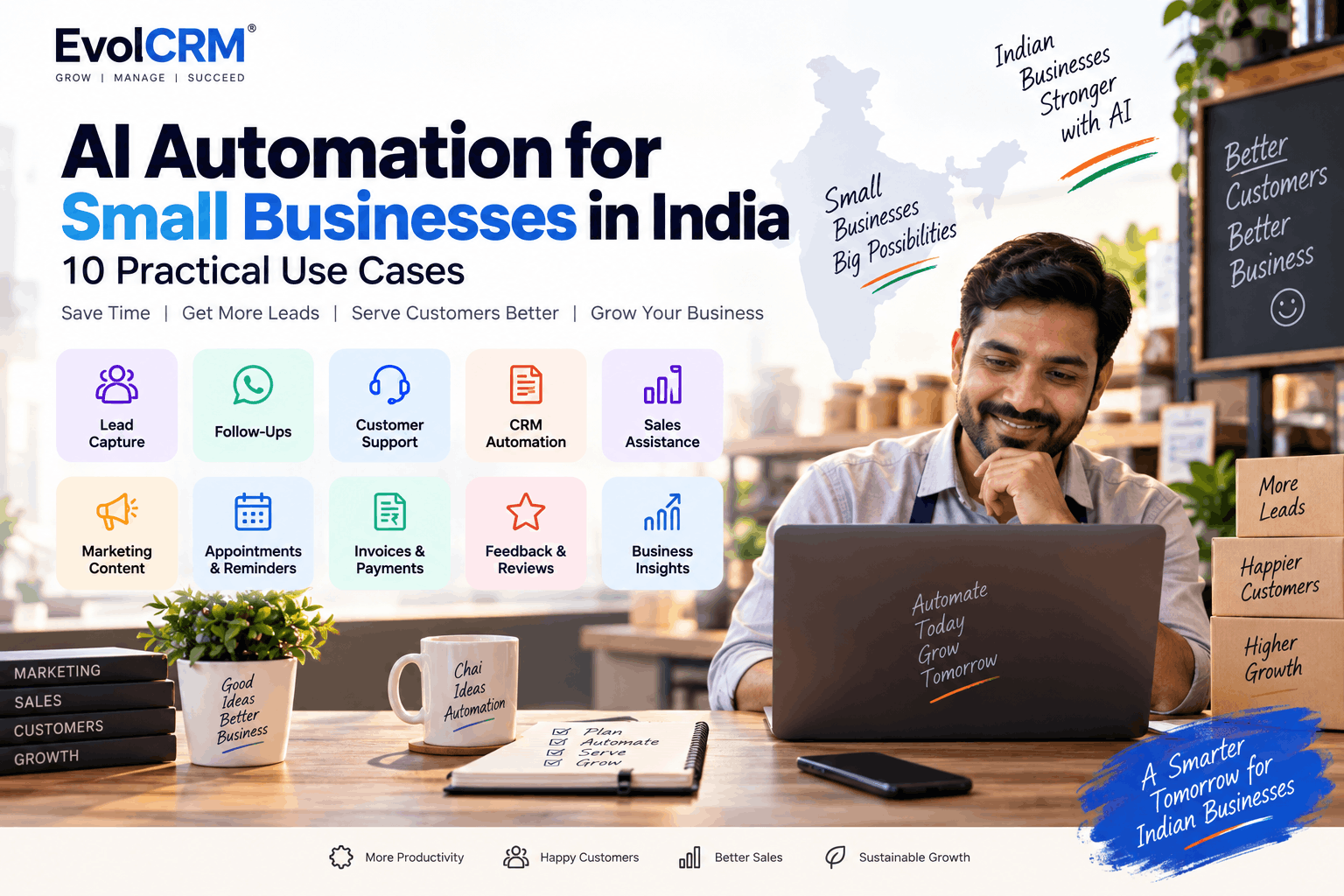
Here are ten practical use cases you can implement without needing a technical team.
1. AI Lead Capture and Lead Qualification
The problem: Your business receives inquiries from website forms, WhatsApp, social media, and phone calls. Someone has to manually collect, sort, and follow up on each one. Leads get lost, and you never know which ones are worth pursuing.
How AI automation works: AI can automatically collect leads from all your channels and categorize them based on location, product interest, budget, urgency, and purchase intent. Instead of a pile of unorganized inquiries, you get a qualified list of prospects ready for your sales team.
Example: A local service business receiving 50 WhatsApp inquiries daily can use AI to instantly capture each lead, classify it, and prioritize follow-ups—without anyone manually copying data. Solutions like Haptik's Interakt allow businesses to deploy WhatsApp AI Agents that resolve up to 80% of repetitive queries automatically.
Benefits: No more lost leads, faster response times, and salespeople spend time only on qualified prospects.
What to automate: Lead capture, initial qualification, and lead scoring.
What needs human approval: Final qualification decisions, pricing negotiations, and closing deals.
2. Automated Lead Follow-Ups
The problem: You meet a potential customer at an event or they fill out a form on your website. Then you forget to follow up. Days later, they've gone to a competitor.
How it works: AI creates a workflow where every new lead is added to your CRM, receives an automated message, gets follow-up reminders, and alerts your sales team when a customer responds. Follow-ups can happen via email, WhatsApp, SMS, or phone-call reminders.
Example: A real estate agent gets 20 leads per week. AI automatically sends a WhatsApp message to each lead, qualifies their interest, and schedules a follow-up. The agent only steps in when a lead shows genuine interest.
Benefits: No lead falls through the cracks, response times improve, and conversion rates go up.
Caution: Always obtain permission before contacting customers and avoid spam. Follow TRAI regulations for promotional communications.
3. AI Customer Support
The problem: Your team spends hours answering the same questions: "What are your business hours?", "How much does this cost?", "Do you deliver to my area?"
How it works: AI agents can answer these repetitive questions instantly across WhatsApp, website chat, and phone calls. When a conversation gets complex, the AI transfers it to a human employee with full context.
Example: A salon uses an AI receptionist to handle appointment bookings, pricing questions, and service inquiries. Customers get instant answers 24/7, while staff focus on serving clients. A dental clinic in Mumbai reduced missed calls by using AI to handle appointment bookings during busy hours.
Benefits: Faster response times, 24/7 availability, and staff freed for higher-value work.
What to automate: FAQs, appointment booking, basic troubleshooting.
What needs human approval: Complex complaints, emergency situations, and personalized consultations.
4. AI-Powered CRM Data Entry
The problem: Your sales team spends more time updating the CRM than actually selling. Every conversation needs to be manually logged, every lead categorized, every follow-up scheduled.
How it works: AI automatically converts customer conversations into CRM notes, extracts names and contact details, summarizes calls, categorizes leads, and creates follow-up tasks.
Example: A B2B service provider uses AI to analyze WhatsApp chats and automatically log customer interactions in their CRM. Sales reps get a complete history without typing a single note.
Benefits: Less administrative work, accurate records, and sales teams spend more time selling.
What to automate: Conversation logging, lead categorization, and task creation.
What needs human oversight: Reviewing AI-generated notes for accuracy before important decisions.
5. AI Sales Assistance
The problem: Your sales team struggles to prioritize leads, remember follow-ups, and personalize messages. Some high-intent prospects get ignored while salespeople chase dead ends.
How it works: AI acts as a sales assistant, summarizing conversations, suggesting follow-up actions, identifying inactive leads, prioritizing high-intent prospects, and drafting personalized messages.
Example: A digital marketing agency uses AI to analyze lead conversations and identify which prospects are ready to buy. The sales team focuses only on warm leads and closes more deals.
Benefits: Better prioritization, more personalized outreach, and higher conversion rates.
Important: AI assists salespeople but should never make final decisions without human oversight.
6. AI Marketing Content Automation
The problem: You need to create content for social media, blogs, email campaigns, and advertisements, but you don't have time or a dedicated marketing team.
How it works: AI can generate first drafts for social media posts, blog articles, email campaigns, product descriptions, and promotional messages based on your input.
Example: A coaching institute uses AI to draft weekly social media posts about upcoming courses. A human team member reviews and customizes each post before publishing.
Benefits: Faster content creation, consistent publishing, and more time for strategy.
Why human review is essential: AI content can be generic or occasionally inaccurate. Always review for brand voice, accuracy, and originality. Fynd's AI Studio, for instance, turns a single product photo into studio-quality images from a prompt, handling what they estimate as 80% of the "grunt work" of building a catalog.
7. Appointment and Reminder Automation
The problem: You lose revenue from missed appointments and spend too much time manually reminding customers.
How it works: AI automates the entire workflow: appointment booking → confirmation → reminder → follow-up.
Example: A clinic uses AI to handle all appointment requests, send confirmation messages, and remind patients 24 hours before their visit. No-shows drop significantly.
Benefits: Fewer missed appointments, less administrative work, and happier customers.
Who benefits: Clinics, salons, coaching centers, consultants, repair services, real estate agencies, and local service providers.
8. AI Invoice and Payment Reminders
The problem: Late payments affect your cash flow, but chasing invoices takes time and can feel uncomfortable.
How it works: AI monitors pending invoices, identifies upcoming and overdue payments, and automatically sends polite reminders to customers.
Benefits: Faster payments, better cash flow, and less manual follow-up work.
Human oversight needed: Financial decisions like extending payment deadlines or forgiving late fees should remain with you. Cashfree's AI Super Agent Relay automates payment operations, handling failed payments and abandoned carts automatically based on the outcome you specify.
9. AI Customer Feedback and Review Management
The problem: You get feedback across WhatsApp, social media, Google reviews, and email, but it's hard to spot patterns and act on them.
How it works: AI analyzes customer feedback across all channels and identifies common themes like service quality, delivery issues, product complaints, and pricing concerns.
Example: An e-commerce business uses AI to review customer messages and identify recurring complaints about delayed delivery. They adjust their logistics provider and see fewer complaints.
Benefits: Better understanding of customer satisfaction, proactive problem-solving, and improved business operations.
Ethical note: Use feedback to genuinely improve your business. Never create fake reviews or manipulate ratings.
10. AI Business Reporting and Insights
The problem: You're running a business but don't have clear visibility into what's working. Are leads increasing? Is the sales pipeline healthy?
How it works: AI summarizes business information and provides insights on new leads, conversion rates, follow-up performance, sales pipeline, and revenue trends.
Example: A small business owner uses AI to generate a weekly report on lead volume, conversion rates, and team performance. The insights help them identify bottlenecks and adjust strategies.
Benefits: Better decision-making, clearer business visibility, and more time to focus on growth.
Note: AI-generated insights should support your decisions, not replace your judgment.
AI Automation by Business Type
Real Estate: Lead qualification and automated follow-ups help agents manage dozens of inquiries without dropping leads.
Coaching Institutes: Student inquiries and appointment reminders keep classes full and reduce no-shows.
Salons: Appointment booking and 24/7 inquiry handling free up receptionists for in-person service.
E-commerce: Customer support and order tracking questions are handled instantly, reducing support tickets.
Digital Agencies: Lead capture and proposal assistance help agencies respond faster to client inquiries.
Local Services: Inquiry management and automated responses ensure no customer question goes unanswered.
Consultants: Appointment scheduling and meeting summaries help professionals stay organized.
Retail: Customer inquiries and promotional campaigns keep stores connected with shoppers.
How CRM Fits Into AI Automation
For AI automation to work effectively, you need a central place to store and organize customer information. A CRM acts as this hub, housing your leads, customers, conversations, follow-ups, tasks, and sales pipeline.
AI becomes more useful when customer information is organized in one system. Instead of scattered notes and spreadsheets, you have structured data that AI can analyze and act on. Platforms like EvolCRM are examples of CRM solutions businesses use to organize leads, customers, follow-ups, and sales activities while integrating with AI agents for WhatsApp communication.
Benefits of AI Automation for Indian Small Businesses
- Save employee time by automating repetitive tasks
- Respond to leads faster and close more deals
- Reduce missed follow-ups and lost opportunities
- Improve customer service with 24/7 availability
- Organize customer information in one central system
- Reduce administrative workload on sales and support teams
- Improve sales-team productivity by prioritizing leads
- Make business reporting easier with automated insights
- Scale operations without immediately increasing administrative workload
Common Mistakes to Avoid
Automating everything immediately – Start with one workflow and build from there.
Using AI without human review – AI makes mistakes; always verify important outputs.
Sending excessive automated messages – Respect your customers' time and privacy.
Ignoring customer privacy – Comply with India's DPDP Act and TRAI regulations.
Using poor-quality customer data – Garbage in, garbage out. Clean your data first.
Choosing tools without checking integrations – Ensure your AI tools work with your existing systems.
Focusing on technology instead of business outcomes – The goal is business growth, not tech adoption.
Not measuring ROI – Track time saved and revenue generated to justify investments.
FAQ
1. What is AI automation for small businesses?
AI automation uses artificial intelligence to handle repetitive business tasks like lead capture, customer support, follow-ups, and data entry, freeing employees for higher-value work.
2. How can small businesses in India use AI?
Indian small businesses are using AI for WhatsApp commerce, customer support, lead qualification, appointment booking, invoice management, and sales assistance.
3. What are the best AI automation use cases for small businesses?
Lead capture, automated follow-ups, AI customer support, CRM data entry, and appointment reminders are among the most effective starting points.
4. Can AI automate lead follow-ups?
Yes. AI can automatically send follow-up messages via WhatsApp, email, or SMS, track responses, and alert your sales team when a lead shows interest.
5. How can AI help with CRM?
AI can automatically log conversations, categorize leads, create follow-up tasks, and summarize customer interactions, reducing manual data entry.
6. Can AI automate customer support?
Yes. AI can handle frequently asked questions, basic troubleshooting, and appointment booking across WhatsApp, phone calls, and website chat.
7. Is AI automation expensive for small businesses?
No. Platforms like Haptik's Interakt offer enterprise-grade AI Agents starting at Rs 10,000, and many CRM platforms include AI features in their basic plans.
8. How can a small business start using AI automation?
Start with one repetitive workflow—like lead capture or customer support—choose a tool that integrates with your existing systems, and gradually expand from there.
9. What is the difference between AI and automation?
Automation follows predefined rules (like sending a confirmation email). AI understands text, classifies information, and generates responses, making it more flexible and intelligent.
10. Can AI replace employees in small businesses?
No. AI assists employees by handling repetitive work, but human oversight remains essential for complex decisions, building relationships, and creative problem-solving.
Conclusion
Small businesses don't need to automate their entire operation overnight. The best approach is to identify one repetitive, time-consuming process and automate it first. Then, add AI where understanding language, generating content, summarizing information, or classifying customer data provides additional value.
The goal isn't to replace people. It's to free up your team's time and energy for what they do best: serving customers, building relationships, and growing the business. Start small, measure results, and scale what works.
If you're using WhatsApp to connect with customers, platforms like EvolCRM can help organize leads, customers, follow-ups, and sales workflows while integrating AI agents for automated customer interactions.