For years, businesses have relied on CRM systems to organize customer information. These platforms store leads, track sales pipelines, record interactions, and help teams manage customer relationships. But traditional CRM systems were designed for a slower, more linear world. They capture what happened — they rarely guide what should happen next. They act as the memory of the enterprise, not the intelligence layer.
This is where AI CRM software changes the equation.
Modern businesses manage leads from multiple channels, customers across time zones, follow-ups that multiply daily, support requests that never sleep, and WhatsApp conversations that blend personal and professional. A traditional CRM can organize this information. AI capabilities can help analyze it, automate repetitive workflows, assist employees with recommendations, and surface insights that humans might miss.
The shift toward AI-native CRM marks a transition from passive data capture to systems that understand context, interpret signals, and shape decisions in real time.
But AI CRM is not automatically better for every business. This guide explains what AI CRM software is, how it differs from traditional CRM, its features and benefits, practical use cases, implementation considerations, costs, and how to decide whether AI-powered CRM is appropriate for your business.
What Is AI CRM Software?
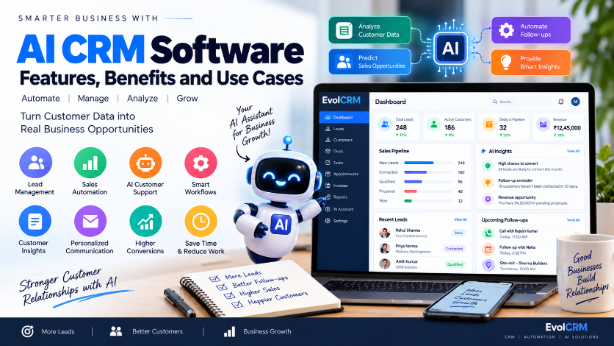
AI CRM software is a customer relationship management platform that uses artificial intelligence to analyze customer data, automate everyday tasks, recommend actions, generate insights, and assist users with different CRM activities.
The distinction matters. Simply adding a chatbot or an AI writing feature does not necessarily make a CRM intelligent across the entire customer journey. AI becomes more useful when it can work with customer context and business data.
Traditional CRM systems follow structured records and predefined processes. When a new lead enters the system, a traditional CRM can create a lead record, assign it to a sales representative, record calls and emails, move the lead through predefined stages, trigger reminders, and generate reports. Automation can reduce repetitive work, but the system generally follows rules the business creates.
AI CRM adds an intelligence layer to this foundation. It can:
- Analyze customer data to identify patterns and predict outcomes
- Automate content generation and response drafting
- Recommend next steps based on historical success patterns
- Handle natural language queries from users
- Monitor relationship health and flag at-risk accounts
The market reflects growing demand. The global AI CRM tools market is predicted to grow from US8.7billionin2025toUS
8.7billionin2025toUS 15.1 billion in 2032, at a compound annual growth rate of 8.1%.
AI CRM vs Traditional CRM: Key Differences
Understanding the difference helps businesses make an informed decision.
Traditional CRM: System of Record
Traditional CRM platforms were designed to centralize customer data and standardize processes. They excel at:
- Storing customer and company information
- Tracking leads and opportunities
- Managing sales pipelines
- Recording customer interactions
- Automating predefined workflows
- Generating reports and dashboards
But traditional CRM has limitations. It depends heavily on manual data entry. It relies on predefined rules that break when reality changes. Reports require human interpretation. And the system waits passively for someone to notice a problem or opportunity.
AI CRM: System of Intelligence
AI CRM shifts the logic. Instead of waiting for data to be manually entered into fields, it interprets signals and infers meaning. It moves CRM from documentation to direction by surfacing patterns, sentiment, intent, and risk — then translating them into timely recommendations.
Key differences include:
Lead scoring: Traditional CRM assigns points based on demographic attributes. AI CRM learns continuously from actual outcomes, analyzing historical win and loss patterns, behavioral sequences, and contextual signals to generate dynamic conversion probability scores that update in real time.
Relationship management: Traditional CRM shows you the data. AI CRM tells you which relationships need attention and why.
Workflow automation: Traditional CRM follows "if-this-then-that" logic. AI agents can reason dynamically about what the goal is, what information is missing, and what action will move things forward.
Content creation: Traditional CRM stores notes. AI CRM can generate follow-up emails, summarize conversations, and draft responses.
Key Features of AI CRM Software
AI Lead Scoring and Prioritization
Traditional lead scoring uses static rules. AI lead scoring analyzes historical conversion patterns, behavioral signals, engagement frequency, and contextual factors to generate dynamic scores. The system learns from every won and lost deal, continuously improving its predictions.
For sales teams, this means spending less time on leads that will not convert and more time on opportunities that matter.
Predictive Analytics and Forecasting
AI CRM can analyze historical sales data, pipeline information, and current deal activity to forecast likely outcomes. This helps sales leaders understand future revenue with greater confidence and plan resources accordingly.
Beyond simple forecasting, predictive analytics can identify:
- Deals at risk of stalling
- Customers likely to churn
- Accounts ready for upsell or cross-sell
- Seasonal patterns in customer behavior
Generative AI for Content
AI CRM systems can use large language models to generate emails, summarize conversations, draft responses, and create customer-facing content. This is particularly valuable when employees spend significant time writing or summarizing information.
Natural Language Interaction
Users do not always need to navigate multiple CRM screens to find information. With natural language capabilities, they can ask questions like "Show me deals at risk this quarter and propose next actions" and receive answers based on available CRM data.
Smart Recommendations and Next Best Action
AI can identify patterns and recommend possible next steps. For example, it might identify a stalled deal, highlight relevant customer history, and suggest a specific follow-up approach based on what has worked in similar situations before.
Next best action intelligence replaces default allocation of attention — answering the latest email, responding to whoever called last — with strategic relationship investment based on value and need.
Relationship Health Monitoring
Customer relationships do not end suddenly. They deteriorate gradually through a sequence of small signals. AI relationship health monitoring analyzes engagement signals across the customer portfolio, generating real-time health scores, identifying deteriorating trajectories, and surfacing specific interventions that have historically reversed similar patterns.
Conversational AI and Customer Support
AI-powered chatbots and virtual agents can deliver immediate customer support, addressing queries and resolving issues promptly, even beyond regular business hours. These systems can handle routine inquiries, freeing human agents for complex issues.
Autonomous AI Agents
The most advanced AI CRM platforms include autonomous software entities that can reason, plan, and act to achieve business goals. Unlike basic automation, AI agents can qualify and prioritize leads without manual rules, draft and send follow-ups based on customer signals, update pipelines automatically, and coordinate actions across sales, marketing, and service.
Benefits of AI CRM Software
Improved Sales Efficiency
AI CRM reduces administrative drag, enabling teams to spend more time with customers and less time updating fields. Natural language queries, automated data entry, and AI-generated content all reduce the manual workload that traditionally consumes sales time.
Better Lead Conversion
AI lead intelligence analyzes thousands of historical win and loss patterns to generate dynamic conversion probability scores. Sales leaders manage a prioritized intelligence feed rather than a static list, directing attention where it will create the most value.
Enhanced Customer Experience
AI enables hyper-personalized customer experiences. By analyzing real-time behavioral insights and historical data, businesses can tailor messaging, offers, and support to individual customer needs. This evolution transforms CRM from a reactive tool into a proactive engagement engine.
Proactive Problem Detection
AI relationship health monitoring makes deterioration visible while there is still time to act. Instead of discovering a lost customer after they have already left, businesses can intervene when signals first appear.
Reduced Operational Costs
Fewer manual tasks, smarter execution, and consolidated tools reduce both cost and friction. AI handles routine inquiries, freeing human agents for higher-value work. Automated workflows reduce the need for constant human monitoring.
Data-Driven Decision Making
AI CRM turns stored data into actionable intelligence. Forecasting becomes grounded in real-time signals rather than intuition. Reports become insights. Patterns emerge from noise.
Practical Use Cases for AI CRM
Small Business and Startups
For small businesses without dedicated sales operations teams, AI CRM can act as a force multiplier. AI lead scoring helps prioritize limited time. Automated follow-ups ensure no lead is forgotten. Natural language queries make CRM accessible to team members who lack training.
The AI-powered CRM platform market is segmented by organization size, with small and medium enterprises as a distinct segment reflecting growing adoption beyond large enterprises.
Service Businesses
Service businesses — pest control, cleaning, repair, maintenance — depend on scheduling, follow-ups, and recurring relationships. AI CRM can automate appointment reminders, track service history, predict when customers will need repeat service, and flag at-risk accounts before they churn.
Digital Agencies
Agencies manage multiple clients, projects, proposals, and communication streams. AI CRM can help track proposal follow-ups, monitor client health, generate status update drafts, and identify upsell opportunities based on service usage patterns.
Customer Support Teams
AI-powered chatbots and virtual agents can handle routine support inquiries, provide 24/7 responsiveness, and escalate complex issues to human agents with relevant context. Research shows that hybrid human-AI support models significantly improve first-contact resolution rates and reduce average handling time.
Sales Teams
AI sales automation helps representatives focus on selling rather than administrative work. AI agents can qualify leads, prepare meeting research, track deal progress, flag risks, and draft follow-up communications.
Retail and E-commerce
In Indian retail, AI is transforming CRM by helping businesses understand buying behavior, improve brand communication, and enhance customer relationships. AI algorithms analyze extensive customer data to reveal hidden insights on preferences and future behaviors.
AI CRM for Small Business in India
For small businesses in India, AI CRM software offers specific advantages:
Multi-channel management: Indian businesses often communicate through WhatsApp, phone calls, email, and in-person interactions. AI CRM can unify these channels into a single customer view.
Cost efficiency: Cloud-based AI CRM platforms eliminate the need for extensive IT infrastructure. Subscription models make advanced capabilities accessible to smaller organizations.
Scalability: As the business grows, AI CRM scales without requiring proportional increases in administrative staff.
Local context: AI CRM systems can be configured for Indian business contexts, including GST invoicing, regional language support, and local communication preferences.
The Indian retail sector has seen significant influence of AI on CRM experience, with businesses increasingly applying automation and AI technologies to understand customer behavior and enhance relationships.
AI CRM Implementation Considerations
Data Quality Foundation
AI intelligence is only as reliable as the data it reasons over. Organizations that skip data cleaning and unification are automating their ignorance at machine speed. Before implementing AI CRM, ensure customer data is standardized and consistent across systems.
Integration with Existing Systems
AI CRM needs to connect with email, WhatsApp, payment gateways, accounting software, and other business tools. Data silos and legacy systems create integration challenges that influence vendor selection.
User Adoption
When teams are attached to their current workflows, adoption can slow. Focus on training employees through workshops and courses. Look for platforms with built-in training resources.
Security and Governance
CRM systems centralize customer data, so implementations need strong permissions and governance over what information gets captured and how it is used. This is particularly important when AI is involved in generating recommendations.
Data Privacy Compliance
Stringent data privacy laws impose strict requirements on organizations managing customer data. Compliance obligations necessitate comprehensive governance frameworks and auditing processes, potentially hindering rapid implementation.
AI CRM Costs
The cost of AI CRM software varies significantly based on:
Platform type: Ready-made AI CRM platforms typically charge subscription fees per user per month. Costs increase with user count and feature tier.
Custom development: Custom AI CRM development involves upfront investment in design, development, integration, and testing. Ongoing costs include hosting, maintenance, and AI API usage.
AI capability level: Basic AI features (chatbots, simple automation) cost less than advanced capabilities (autonomous agents, predictive analytics, custom model training).
Integration complexity: Connecting AI CRM to existing systems — ERP, accounting, WhatsApp, payment gateways — adds integration development costs.
Data volume and usage: If the AI CRM uses external AI APIs, costs scale with usage. Large conversation volumes or extensive document processing increase API costs.
For small businesses, cloud-based subscription AI CRM platforms generally offer the lowest entry point. Custom development makes sense when business workflows are highly specialized or integration requirements are unique.
Security Considerations for AI CRM
AI CRM systems handle sensitive customer data, making security essential.
Access control: Implement role-based permissions so employees only access the data they need. A sales representative does not need access to all customer payment information.
API key management: If the AI CRM integrates with external AI services, API keys must be stored securely on the server — never exposed in frontend code.
Data encryption: Ensure data is encrypted in transit (HTTPS) and at rest.
Audit logging: Log AI suggestions, human edits, and actions for post-hoc audits and compliance.
Prompt injection protection: When AI agents can access business systems or tools, protect against malicious input attempting to manipulate AI behavior.
Regular backups: Maintain regular database backups and test recovery procedures.
Common AI CRM Implementation Mistakes
Starting with AI before data is clean: AI amplifies whatever data quality exists. Poor data produces poor AI outputs.
Automating without oversight: AI agents should operate within defined boundaries. Human-in-the-loop controls are essential, especially for customer-facing actions.
Over-automating customer interactions: The goal of automation is not to remove human interaction. It helps employees spend less time on repetitive work so they can focus on moments that require human judgment.
Ignoring user training: Even the best AI CRM fails if teams do not understand how to use it effectively.
Underestimating integration work: Connecting AI CRM to existing systems often requires more effort than expected.
Skipping privacy documentation: Businesses should clearly communicate how customer data is used, especially when AI processes it.
Building too many features initially: Start with core AI capabilities that solve the most important business problems. Expand as requirements become clearer.
Future of AI CRM
The trajectory is clear: CRM is becoming AI-native. The question is not whether AI will be part of CRM, but how deeply it will be embedded.
From assistive to agentic: Early AI CRM features assisted humans. The next phase involves AI agents that can execute multi-step processes autonomously within defined boundaries.
From reactive to anticipatory: AI CRM is moving from describing what happened to predicting what will happen and recommending what to do about it.
From single-channel to orchestrated: AI CRM will increasingly orchestrate customer engagement across email, WhatsApp, voice, chat, and in-person interactions from a unified intelligence layer.
From generic to personalized: Hyper-personalization will become standard, with AI tailoring every interaction based on individual customer context and behavior.
How to Choose the Right CRM Approach
Not every business needs AI CRM. Here is a practical framework:
Choose spreadsheets or basic CRM when:
- You have very few customers
- Your workflow is simple
- You do not require automation
- Budget is extremely limited
Choose traditional CRM when:
- You need standard CRM features
- Your workflow follows predictable patterns
- Manual data entry is manageable
- You prefer straightforward implementation
Choose AI CRM when:
- You manage high volumes of leads or customers
- Follow-ups are critical and easily missed
- You need predictive insights for decision-making
- Your team spends too much time on administrative tasks
- You want to scale customer relationships without proportional staff increases
Choose custom AI CRM development when:
- Your workflow is highly specialized
- You need integrations not supported by ready-made platforms
- You require full control over data and AI models
- AI CRM will become a core business platform
Conclusion
AI CRM software represents a fundamental shift in how businesses manage customer relationships. Traditional CRM captured data. AI CRM interprets it, learns from it, and acts on it.
The benefits are tangible: better lead prioritization, proactive problem detection, reduced administrative burden, and more personalized customer experiences. The global market reflects this: AI CRM tools are projected to grow at 8.1% annually through 2032.
But AI CRM is not a universal solution. It requires clean data, thoughtful implementation, security controls, and appropriate human oversight. For businesses with simple workflows and few customers, traditional CRM or spreadsheets may remain sufficient.
The most practical approach is to start with the business problems that matter most — missed follow-ups, inefficient lead qualification, reactive customer support — and evaluate whether AI capabilities address those problems better than traditional tools.
EvolCRM Software Solution Agency provides software development and CRM solutions for businesses that need customized digital systems. A business-specific AI CRM can be designed around actual customer workflows, reporting requirements, and automation needs rather than forcing the business to adapt to generic software.
Frequently Asked Questions
What is AI CRM software?
AI CRM software is a customer relationship management platform that uses artificial intelligence to analyze customer data, automate tasks, recommend actions, generate insights, and assist users with CRM activities. It adds an intelligence layer to the data and processes already stored in a traditional CRM.
How does AI CRM differ from traditional CRM?
Traditional CRM stores data and follows predefined rules. AI CRM analyzes data, learns from patterns, and recommends or executes actions. Traditional CRM is a system of record. AI CRM is a system of intelligence.
What are the main features of AI CRM software?
Key features include AI lead scoring, predictive analytics, generative AI for content, natural language queries, smart recommendations, relationship health monitoring, conversational AI, and autonomous AI agents.
What are the benefits of AI CRM for small businesses?
Small businesses benefit from better lead prioritization, automated follow-ups, reduced administrative workload, and access to insights that would otherwise require dedicated sales operations teams.
Can AI CRM generate leads?
Yes. AI CRM can qualify and prioritize incoming leads, identify prospects most likely to convert, and automate initial outreach. Some AI agents can conduct research on prospects and prepare personalized communication.
Is AI CRM suitable for service businesses?
Service businesses benefit from AI CRM through appointment reminders, service history tracking, predictive maintenance scheduling, and relationship health monitoring that flags at-risk customers before they churn.
How much does AI CRM software cost?
Costs vary widely. Cloud-based subscription platforms charge per user per month. Custom development involves upfront investment plus ongoing hosting, maintenance, and AI API usage. The right approach depends on business size, workflow complexity, and integration requirements.
Can AI CRM integrate with WhatsApp?
Yes. AI CRM platforms can integrate with WhatsApp Business APIs to support customer communication, notifications, and conversational workflows, subject to platform requirements.
What security considerations apply to AI CRM?
Key considerations include access control, API key management, data encryption, audit logging, prompt injection protection, and regular backups. AI systems that access business data require appropriate authorization controls.
Is AI CRM better than traditional CRM?
Neither is universally better. AI CRM is appropriate when businesses need predictive insights, automation of complex workflows, or proactive relationship management. Traditional CRM remains suitable for simpler workflows with lower volumes.