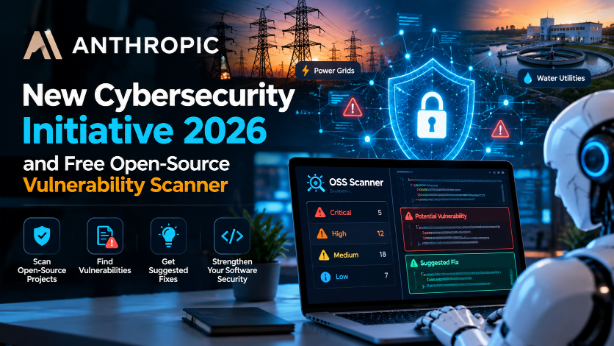
Anthropic launched its Cyber Mission and OSS Scanner on October 8, 2026, offering free AI-powered vulnerability scans for eligible open-source projects. The scanner uses Anthropic's strongest AI models—including Claude Mythos—to detect security flaws, though reports come without human review, meaning maintainers must validate findings before acting.
Key Takeaways:
- Anthropic Cyber Mission is a long-term initiative to strengthen cybersecurity in critical infrastructure and open-source software
- OSS Scanner provides free, periodic AI-driven security scans for opt-in open-source projects
- Reports are fully AI-generated without human triage, trading accuracy for speed
- Projects must meet eligibility criteria and enroll via GitHub pull request
- AI findings require human validation before fixes should be deployed
What Is Anthropic’s Cyber Mission?
Anthropic announced the Anthropic Cyber Mission on October 8, 2026, describing it as a long-term commitment to help defenders protect systems society depends on. The initiative provides tools, research, engineering support, and funding to cybersecurity defenders, with an initial focus on two areas: critical infrastructure and open-source software.
The company framed the initiative around a simple reality: AI capabilities that help defenders find vulnerabilities can also help attackers exploit them. By putting frontier models directly in the hands of defenders, Anthropic aims to create what it calls a “permanent advantage” for security teams.
What Is Anthropic’s Critical Infrastructure Defense Program?
The Critical Infrastructure Defense Program (CIDP) is the critical infrastructure arm of Anthropic’s Cyber Mission. It provides frontier Claude models, on-site engineers, and threat research to security providers that protect operational technology (OT) used in power grids, water systems, transportation networks, and industrial facilities.
The program’s founding partners include 11 organizations: Accenture, Booz Allen Hamilton, CrowdStrike, Deloitte, Dragos, Hitachi, Insane Cyber, Nozomi Networks, Palo Alto Networks, PwC, and Rockwell Automation. These partners span consulting firms, security vendors, and industrial equipment manufacturers—covering the key roles that critical infrastructure operators depend on.
The focus on OT is significant. Unlike traditional IT systems, industrial control equipment often runs for decades, cannot easily be taken offline for patching, and may contain known vulnerabilities that remain unaddressed for years. Anthropic says several partners are already using Claude to identify and fix vulnerabilities, though the company has not disclosed the financial arrangements for these partnerships.
What Is Anthropic OSS Scanner?
OSS Scanner is a free, opt-in vulnerability scanning service for open-source projects. Anthropic describes it as inspired by Google’s OSS-Fuzz, which has provided automated fuzzing for open-source software since 2016.
Projects that enroll receive periodic security scans performed by Anthropic’s “strongest models,” including Claude Mythos. Reports include a reproduction procedure, an explanation of the vulnerability, and—where available—a suggested patch.
The critical caveat: OSS Scanner reports are fully model-generated without human review or triage. Anthropic explicitly warns that this trade-off enables faster and more frequent scanning but means reports may be incorrect or invalid.
Eligibility and Access
OSS Scanner prioritizes projects with significant impact on infrastructure or user security, particularly those exposed to remote attacks. Eligibility is decided case by case, and Anthropic says it uses criteria similar to OSS-Fuzz.
Core maintainers enroll by opening a pull request on the OSS Scanner GitHub repository with a YAML configuration file containing:
- Link to the Git repository to clone
- Primary contact email
- Path to a Dockerfile that sets up the build environment and dependencies
The Dockerfile creates an isolated environment where the AI agent performs its audit. Anthropic recommends verifying that test cases pass inside the built container before enrollment.
As of the October 8 announcement, 116 pull requests had been submitted.
Early Results
Anthropic reported that during Project Glasswing—its predecessor initiative—the company scanned hundreds of open-source projects and identified more than 29,000 candidate vulnerabilities over six months. Human reviewers were able to manually validate only about 6,000 of these, revealing a significant bottleneck that OSS Scanner aims to address.
In validation testing, penetration testers assessed 97 high- and critical-severity findings across 48 projects. Of these, 85 met Anthropic’s coordinated disclosure criteria, 11 were genuine but duplicative, and one was judged invalid.
How AI-Powered Vulnerability Scanning Works
Anthropic has described how its security models operate, though not all details apply specifically to OSS Scanner.
Rather than scanning for known vulnerability patterns like traditional static analysis tools, Claude-based security tools reason about code like a human security researcher. They read source code, trace how data flows through applications, and analyze how components interact across files and modules. This approach aims to catch complex, context-dependent vulnerabilities—such as broken access control or business logic flaws—that rule-based tools often miss.
When Claude Security (Anthropic’s paid enterprise product) identifies a potential issue, it provides:
- A confidence rating indicating the likelihood the vulnerability is real
- Severity assessment and likely impact
- Reproduction steps
- Instructions for a targeted patch
A multi-stage validation pipeline independently re-examines each finding before it reaches an analyst, which Anthropic says reduces false positives.
Important distinction: OSS Scanner reports skip the human review stage entirely. Claude Security, the enterprise product, includes human-in-the-loop validation. OSS Scanner prioritizes speed and volume over certainty.
Why This Matters for Web Developers and Software Agencies
AI-assisted vulnerability detection has practical implications across common development scenarios, though these are potential applications of the technology rather than confirmed OSS Scanner features.
For PHP and MySQL applications: AI scanners can reason about SQL query patterns, trace user input through application layers, and flag potential injection points that parameterized queries would prevent.
For JavaScript and API-based websites: Modern applications often expose dozens of API endpoints with complex authentication flows. AI models can analyze whether authorization checks are applied consistently across routes.
For Android applications: Mobile apps frequently handle sensitive data locally and communicate with backends. AI-based analysis could help identify insecure data storage or improper certificate validation.
For authentication systems: Broken access control remains a leading vulnerability category. AI scanners that trace data flows can potentially catch logic flaws that pattern-matching tools miss.
For open-source dependencies: Most projects rely on external libraries. While OSS Scanner targets the projects themselves, maintainers of those dependencies benefit from earlier vulnerability detection, which cascades to downstream users.
How to Improve Website and Application Security in 2026
Whether or not you use AI scanning tools, these practices remain foundational:
- Audit outdated packages and dependencies regularly. Known vulnerabilities in libraries are among the most common attack vectors.
- Scan code for common weaknesses using tools like Semgrep or OWASP ZAP before deployment.
- Store API keys and secrets securely in environment variables or dedicated secret managers—never in source code.
- Enforce strong authentication and authorization with multi-factor authentication and role-based access controls.
- Validate all inputs and use parameterized queries for database operations.
- Configure HTTPS and secure session cookies across all environments.
- Apply least-privilege access controls so a compromised account cannot access more than necessary.
- Maintain tested backups and recovery procedures—and verify they actually work.
- Review logs and monitor suspicious activity with alerting on unusual patterns.
- Run security tests before production deployment, including dependency scans and basic penetration testing.
Benefits and Limitations of AI Vulnerability Scanners
Benefits include:
- Faster analysis than manual code review
- Ability to scan entire codebases at scale
- Detection of complex, context-dependent issues that rule-based tools miss
- Early detection before code reaches production
Limitations are equally important:
- False positives waste developer time and erode trust
- Missed vulnerabilities create dangerous false confidence
- Incorrect or unsafe suggested fixes can introduce new problems
- Context-dependent issues may be misunderstood by AI lacking business logic awareness
- Privacy risks when uploading proprietary code to third-party services
- No substitute for human review and regression testing
A clean scan does not guarantee security. AI-generated findings are not proof of an exploitable vulnerability. Treat AI output as a starting point for investigation, not a verdict.
How Small Businesses Can Adopt AI-Assisted Security
For organizations without dedicated security teams, a practical workflow might look like:
- Start with dependency scanning using free tools that check for known vulnerable packages.
- Run AI or pattern-based code scans on critical application components.
- Review findings manually before making changes—prioritize high-confidence issues.
- Test fixes in staging before deploying to production.
- Keep backups current and verify restoration procedures.
- Schedule periodic security assessments—quarterly at minimum.
The goal is not perfection but consistent improvement and risk reduction.
Frequently Asked Questions
What is Anthropic OSS Scanner?
OSS Scanner is a free, opt-in vulnerability scanning service for open-source projects, announced October 8, 2026. It uses Anthropic’s strongest AI models to perform periodic security scans and email reports to maintainers. Reports are fully AI-generated without human review.
Is Anthropic OSS Scanner free?
Yes. Anthropic states that eligible projects receive scans “at no cost.” There are no disclosed fees for participation.
Who can use Anthropic’s reported vulnerability scanner?
Core maintainers of open-source projects with significant infrastructure or user-security impact. Enrollment requires a GitHub pull request with configuration details. Eligibility is decided case by case.
Can AI detect all software vulnerabilities?
No. AI models can find many vulnerability types but cannot guarantee complete coverage. Complex business logic flaws, issues requiring runtime context, and novel attack patterns may be missed. AI supplements—not replaces—human security review.
Are AI-generated security reports always accurate?
No. Anthropic explicitly warns OSS Scanner reports may be incorrect or invalid. In validation testing, most high-severity findings were genuine, but errors do occur. Always verify before acting.
Which tools can developers use to scan source code?
Options include OWASP ZAP, Semgrep, Trivy, and dependency auditing tools like npm audit or pip-audit. Claude Security offers AI-powered scanning for enterprise customers.
How can a small business secure its website?
Focus on fundamentals: keep software updated, use strong authentication, validate inputs, maintain backups, and monitor for suspicious activity. Periodic scanning adds a useful layer of detection.
Should AI-generated security fixes be deployed directly to production?
No. AI-suggested patches should be reviewed by a developer, tested in staging, and validated before production deployment. AI can misunderstand context or introduce regressions.
Conclusion
Anthropic’s Cyber Mission and OSS Scanner represent a significant experiment in applying frontier AI to cybersecurity defense. For open-source maintainers, the free scanning service offers earlier detection of potential vulnerabilities—with the important caveat that reports require human validation. For businesses and developers, the initiative signals that AI-assisted security is becoming more accessible, even as it underscores that AI findings alone are never sufficient.
Secure software still requires human review, testing, monitoring, and responsible deployment practices. AI accelerates discovery; people ensure quality.
EvolCRM provides software development, website development, and application maintenance services. Explore our resources on website security, API security, and application maintenance to strengthen your development practices.