Claude Code is Anthropic's command-line AI coding agent. It reads your repository, edits files, runs shell commands, and connects to external tools through the Model Context Protocol (MCP). That level of access is what makes it useful—and what makes its sandbox boundaries worth scrutinising.
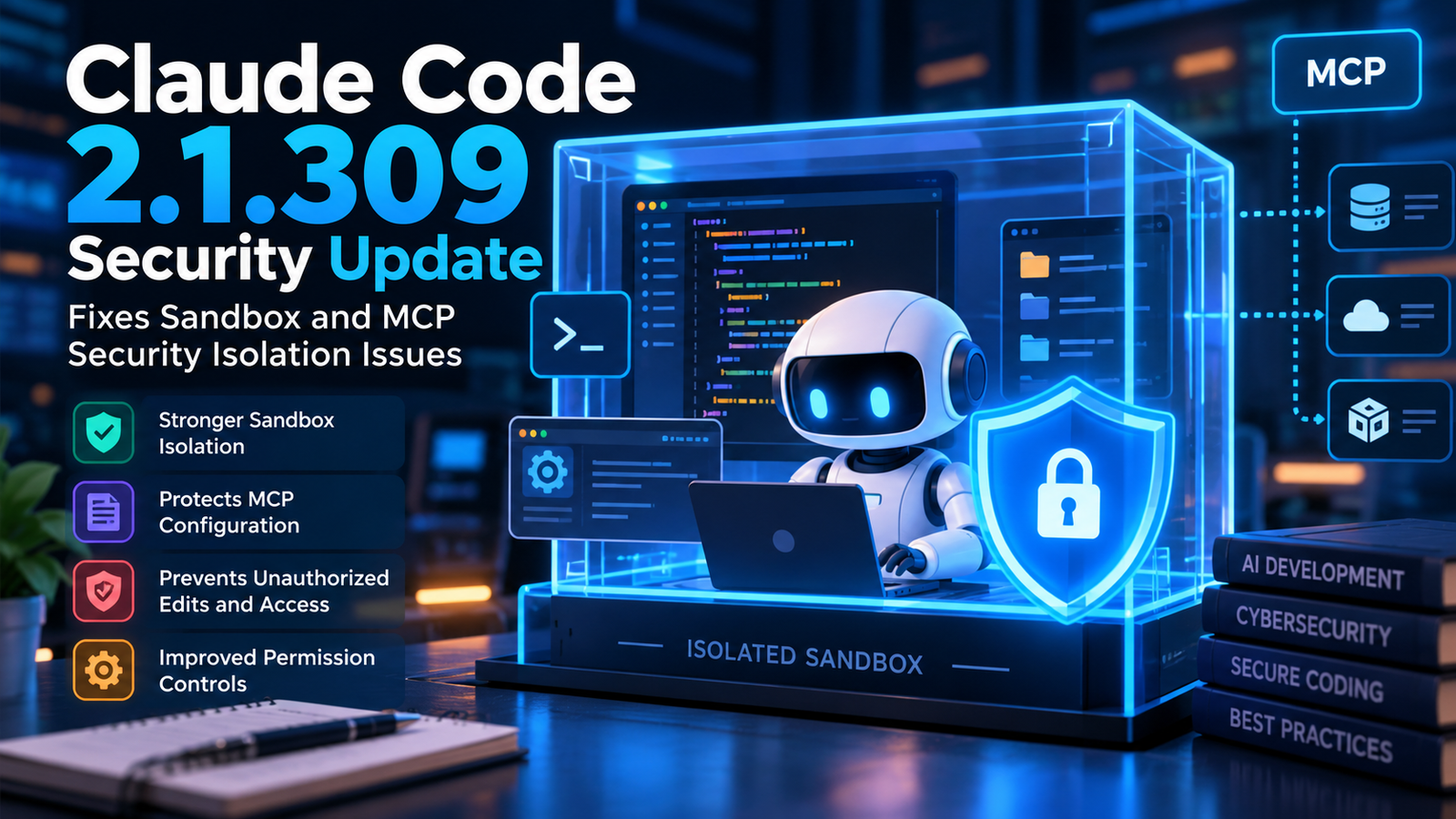
On October 22, 2026, Anthropic released Claude Code 2.1.309, a maintenance update that addresses several permission enforcement and sandbox isolation gaps . This is not a dramatic emergency patch. It is a quiet tightening of the boundaries that separate an AI agent from the rest of your workstation. For developers who run Claude Code against client repositories, production credentials, or shared CI environments, those boundaries deserve attention.
What's New in Claude Code 2.1.309?
The official release notes list a series of fixes rather than a single headline vulnerability . Several of them cluster around the same theme: making sure that commands, configurations, and worktree operations behave the way the sandbox model promises.
Shell startup files and sandbox escape
One fix addresses shell startup files that could execute outside the sandbox. Shell startup files—.bashrc, .zshrc, and their variants—run whenever a new shell session begins. If a command triggered by Claude Code causes a shell to initialise in a way that bypasses the sandbox wrapper, those files can execute with the user's full privileges rather than the restricted sandbox context. The 2.1.309 release tightens this path so that sandboxed sessions do not silently inherit unsandboxed shell initialisation .
MCP configuration supplied through --mcp-config
The release also hardens the handling of MCP servers configured via the --mcp-config flag. MCP servers are external processes that expose tools to Claude. When supplied through a command-line flag, the trust decision becomes less visible than a project-level configuration file. The patch ensures that these servers are not reconnected or trusted after a permission state change without the appropriate checks .
This matters because MCP trust has been a recurring weak point. Earlier research demonstrated that .mcp.json trust decisions could persist by server name alone, allowing a modified configuration to execute without re-prompting . While 2.1.309 does not claim to fix every MCP trust design issue, it closes specific enforcement gaps in how --mcp-config servers interact with permission prompts.
Sandboxed commands and auto-accepted edits
A third cluster of fixes concerns worktree isolation. Claude Code can create isolated Git worktrees for sessions, intended to prevent changes from leaking into the main working directory. Version 2.1.309 fixes cases where worktree-isolated sessions on zsh accepted arithmetic commands the isolation guard should have refused, and where locale-prefixed commands bypassed the same guard .
There is also a fix for sed -i behaviour. In earlier versions, sed -i was treated as a simulated file edit that could be restored with /rewind. In 2.1.309, it runs through the normal Bash permission prompt and is no longer restorable through /rewind . That is a deliberate trade-off: fewer silent edits, more explicit permission checks.
Permission enforcement bypasses
The release notes include several permission-check corrections. A Bash permission check was fixed for compound commands that change directory before running git when the cd is wrapped or prefixed . An Edit(path) deny rule was fixed to block Bash redirects to that path in commands that also held a subshell. And a disabled MCP server could previously be reconnected by a later permission prompt in print and SDK sessions; that path is now closed .
None of these fixes are accompanied by a CVE in the release notes. They are hardening changes, not a disclosure of a single exploitable flaw.
Why These Security Fixes Matter
AI coding agents occupy an unusual position in a developer's environment. They need read access to source code, write access to files, and the ability to execute commands. In many setups, they also inherit the developer's credentials—SSH keys, cloud tokens, API secrets.
When a sandbox boundary fails, the agent is no longer the only thing at risk. A malicious repository, a compromised dependency, or a tampered MCP configuration can use the agent as a pivot. Earlier Claude Code vulnerabilities have demonstrated exactly this pattern: repository-controlled configuration leading to command execution, API key exposure, and sandbox escapes through Git worktree manipulation . A zero-click credential theft flaw in the Desktop preview pane showed that even features assumed to be sandboxed could leak sensitive files .
The 2.1.309 fixes are incremental, but they target the same attack surface: the places where the agent's permissions meet the operating system's execution model. For agencies running Claude Code against multiple client repositories, or for teams using it in CI pipelines, these boundaries are not abstract. They determine whether a malicious pull request can execute something on a developer's machine.
What Developers Should Do
A practical checklist based on the confirmed changes and general security practice:
Update to 2.1.309 or later. The release is available through the official distribution channel. If your team pins versions, verify the new pin before rolling it out.
Check your installed version. Run claude --version. The 2.1.309 release identifies itself as 2.1.309 (Claude Code) .
Review shell startup files in sandboxed contexts. If your workflow depends on .zshrc or .bashrc running inside sandboxed sessions, test the behaviour after updating. The fix changes when those files execute.
Audit --mcp-config usage. If you supply MCP servers via command-line flags, confirm that the servers you expect are the ones being trusted. The release hardens this path, but configuration hygiene still matters.
Re-test worktree-isolated workflows. If you rely on worktree isolation for parallel sessions, verify that zsh arithmetic commands and locale-prefixed commands behave as expected after the update.
Review generated commands before execution. The sed -i change means fewer edits are silently reversible. Treat Bash-based edits with the same scrutiny you apply to any command the agent proposes.
How to Check and Update Claude Code
To check your version:
text
claude --version
The output should read 2.1.309 (Claude Code) or a later version .
Update methods vary by installation. If you installed Claude Code through npm, the package is @anthropic-ai/claude-code. If you use a system package manager or a container image, follow that channel's update process. The release is published on the official GitHub releases page . Do not assume that every installation uses the same package manager; confirm the method you originally used.
Impact on AI Coding Tools
Claude Code 2.1.309 is a reminder that the security model of an AI coding agent is not a single feature. It is the sum of many small enforcement decisions: when a shell starts, when a config file is trusted, when a worktree guard applies, when a permission rule actually blocks a redirect.
The broader lesson for teams adopting AI coding tools is that sandboxing is necessary but not sufficient. Research into MCP configuration trust has shown that a user's initial trust decision can persist in ways that were not intended . The pattern across Claude Code's recent history is one of iterative hardening: each release closes specific gaps, and new gaps surface elsewhere .
For developers building with these tools, the practical implication is to treat the agent's permissions as a least-privilege problem. Give it access to the repository it needs, not the home directory. Keep production credentials out of reach. Review what it proposes to run.
Frequently Asked Questions
What is Claude Code 2.1.309?
It is a maintenance release of Anthropic's command-line AI coding agent, published on October 22, 2026. It focuses on sandbox isolation, MCP configuration handling, and permission enforcement fixes .
What security issues does this release address?
The fixes cover shell startup files executing outside the sandbox, --mcp-config server trust handling, worktree isolation bypasses for certain zsh commands, and several permission-check gaps including sed -i behaviour and Bash redirect rules .
What is MCP in AI coding tools?
The Model Context Protocol is a standard for connecting AI models to external tools and data sources. In Claude Code, MCP servers expose additional capabilities, and their configuration determines what the agent can access .
Why are sandbox restrictions important?
A sandbox limits what an AI agent can do if it is manipulated by malicious input. Without working restrictions, a compromised repository or configuration can cause the agent to execute commands or access files with the developer's full privileges.
Should developers update Claude Code?
Yes. The release closes confirmed enforcement gaps. If you use Claude Code with client repositories, credentials on the same machine, or CI workflows, updating is a reasonable precaution.
Is a sandbox completely secure?
No. Sandboxes reduce risk; they do not eliminate it. Design gaps, configuration mistakes, and features that interact with the operating system outside the sandbox can still create exposure . Treat sandboxing as one layer among several.
Conclusion
Claude Code 2.1.309 is not a headline-grabbing security release. It is a set of corrections to the quiet machinery that decides when the agent's permissions apply and when they do not. For developers who run AI coding agents against real repositories with real credentials, those corrections matter more than their unassuming release notes suggest.
The safest configuration is still the one that assumes the agent will sometimes be wrong, sometimes be manipulated, and sometimes encounter a boundary that has not yet been hardened. Update, check your version, audit your MCP configurations, and keep the blast radius small.
For more guides on AI tools, software development, and practical security, explore the resources at EvolCRM.in.