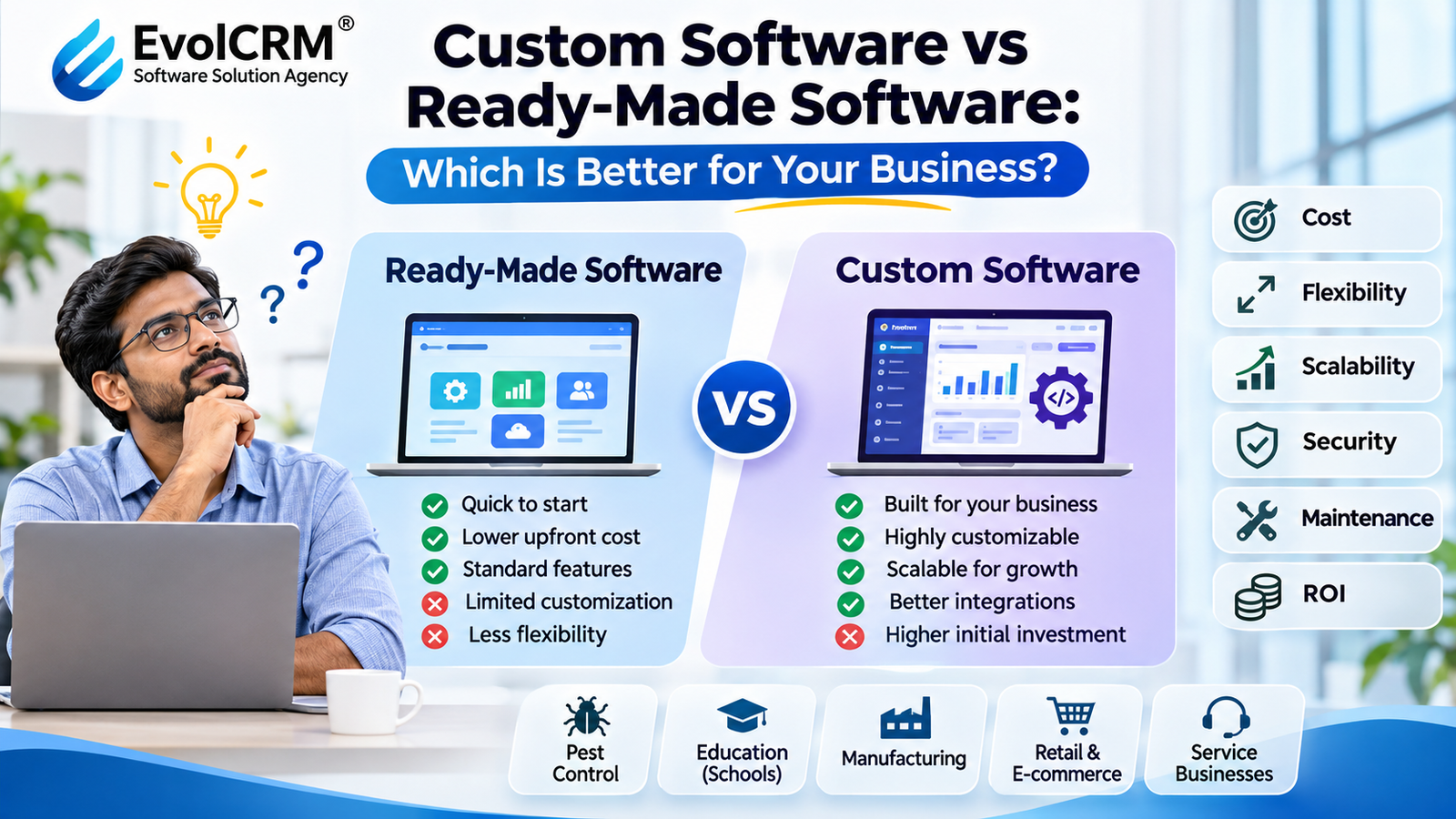
Ready-made software is faster and cheaper to start. Custom software is built around your specific workflows, gives you full ownership, and usually delivers a better long-term return once your operations become complex. Neither is universally better — the right choice depends on how different your processes are, how fast you are growing, and what you can afford upfront.
In 2026, Indian businesses have more software choices than ever. Off-the-shelf SaaS products are more capable, custom development is faster and more affordable than it used to be, and AI tooling has changed the economics of both. That makes custom software development in India a serious option for mid-sized businesses, not just enterprises.
The problem is that most comparison articles pick a side. This guide does not. It explains what each option actually is, what it costs in India in 2026, and when each one makes business sense — with practical examples from Indian companies.
What Is Ready-Made Software?
Ready-made software — also called off-the-shelf, packaged, or SaaS software — is a product built once and sold to many businesses. You subscribe to it, configure it, and use it as-is.
How it works: The vendor owns the code and the product roadmap. You pay a recurring subscription, usually per user or per transaction. You can change settings, add users, and connect some integrations, but you cannot change how the core product behaves.
Common examples in India: Zoho CRM, Tally for accounting, Shopify for e-commerce, Razorpay for payments, Google Workspace for email and collaboration, and vertical SaaS tools for clinics, salons, or schools.
Advantages: Low upfront cost and fast deployment — often live in days or weeks. The vendor handles hosting, security patches, uptime, and upgrades. Large user communities and extensive documentation. Ideal for standard processes like payroll, email, and basic accounting.
Disadvantages: You adapt your business to the software, not the other way around. Per-user pricing becomes expensive as teams grow. Limited customisation beyond what the vendor exposes. Vendor lock-in — price rises, feature removals, or product shutdowns are outside your control. Your data lives on the vendor's infrastructure, which can matter for compliance.
Suitable for: Startups validating a business model, businesses with standard processes, teams without technical capacity, and companies that need a tool quickly rather than a competitive advantage.
What Is Custom Software Development?
Custom software — also called bespoke or tailor-made software — is built specifically for your business. You commission a development partner, define the requirements, and own the resulting code and data.
How it is developed: A typical project moves through discovery, UI/UX design, development, testing, deployment, and handover. A written scope is agreed before coding begins, and the source code, documentation, and IP should transfer to you at the end.
Business-specific functionality: Custom software can encode your pricing logic, approval chains, service schedules, technician tracking, GST invoicing rules, or any workflow that makes your business different. That is the core value — the software fits the business, not a generic template.
Examples of customised software: A pest control company's field-service platform with technician mobile app and automated invoicing; a school ERP with fee collection and attendance; a distributor portal with credit limits and route planning.
Advantages: Exact fit for your workflows, reducing manual workarounds. Full ownership of code, data, and roadmap. Easier integration with existing systems and industry-specific hardware. Scales on your terms — no per-seat penalty for adding staff. Stronger control over data residency and compliance.
Disadvantages: Higher upfront investment than a subscription. Requires a competent development partner and clear requirements. Ongoing maintenance and hosting are your responsibility. Takes months, not days, for anything beyond a small tool.
Suitable for: Businesses with unique workflows, companies outgrowing off-the-shelf limits, organisations needing deep integrations, and businesses where software is a competitive advantage.
Custom Software vs Ready-Made Software – Key Differences
Instead of a dense table, here is how the two options compare across the eleven dimensions that matter most when you are making a purchase decision.
Initial development cost. Ready-made software has a low upfront cost — usually a setup fee or the first month's subscription. Custom software requires a larger one-time development investment before you see any output.
Recurring subscription fees. Ready-made tools charge per user or per transaction, every month, for as long as you use them. Custom software has no per-user subscription — instead you pay for hosting, maintenance, and support, typically around 15–20% of the original build cost per year.
Customisation. Ready-made software limits you to what the vendor exposes in settings and add-ons. Custom software is built to your exact requirements, and you can change it whenever your process changes.
Scalability. With ready-made software, costs rise with each new user, and feature limits may appear as you grow. Custom software scales on your own infrastructure, with no per-seat penalty.
Integration. Ready-made tools offer pre-built connectors, and custom integration may be restricted or paid. Custom software can integrate with any system that exposes an API, including legacy software and industry-specific hardware.
Data control. Ready-made data sits on the vendor's servers, and data residency depends on the vendor. Custom software lets you control hosting, backups, and access — which matters for compliance-sensitive businesses.
Security. With ready-made software, you inherit the vendor's security practices. With custom software, you define security architecture, encryption, and audit trails yourself. Neither is automatically more secure — it depends on how the software is built and maintained.
Maintenance. Ready-made maintenance is included in the subscription. Custom maintenance is your responsibility, either in-house or through a support retainer with your development partner.
Ownership and licensing. With ready-made software, the vendor owns the code and roadmap. With custom software, you own the code, data, and intellectual property.
Support. Ready-made software offers tiered vendor support. Custom software provides direct support from your development partner, which is usually faster and more specific to your business.
Long-term ROI. Ready-made software has predictable but perpetual costs. Custom software has a higher upfront cost but often a lower cost per user at scale, and it improves in value as your business grows into the software.
The honest conclusion: ready-made wins on speed and upfront cost; custom wins on fit, ownership, and long-term economics at scale. The right answer is often a hybrid — buy commodity tools, build what differentiates you.
Need software designed around your business? Talk to EvolCRM about a custom build, or request a free consultation to compare custom vs ready-made for your specific workflows.
Real Business Examples from India
1. Pest control company. Needs customer management, service scheduling, technician tracking, and invoicing. A ready-made field-service SaaS can handle basic scheduling, but if the company uses unique chemical dosage logs, gum-pad replacement cycles, or WhatsApp-based customer confirmation, a custom CRM or field-service platform fits better. EvolCRM builds custom pest-control management systems, including a published PPCS app.
2. School. Needs student records, fee management, and attendance. Standard school ERP products cover this well at low cost. Custom software becomes worthwhile only when the institution has unusual fee structures, multi-branch reporting, or deep integration with a legacy examination system.
3. Manufacturing company. Needs inventory, production planning, and reporting. Off-the-shelf ERP can work for standard production, but Indian manufacturers often need custom Bill of Materials logic, machine-level data capture, or GST-specific reporting. Custom ERP development is common here — but start with a departmental system before committing to a full platform.
4. Retail business. Needs inventory, billing, and customer management. A ready-made POS handles this efficiently. Custom software makes sense when the retailer has multi-store stock transfers, loyalty rules, or a warehouse workflow that no off-the-shelf POS supports.
5. Service company. Needs enquiry management, employee assignment, and automated follow-ups. A custom CRM with WhatsApp integration and automated reminders often pays for itself by reducing missed leads. Ready-made CRMs can work initially, but custom development becomes attractive once the team grows past 10–15 users.
Custom Software Development Cost in India (2026)
Custom software is priced like construction, not like a product on a shelf. The same five factors move almost every quote: scope, integrations, data and logic complexity, design polish, and scale.
Illustrative ranges in INR for 2026 — clearly labelled as planning ranges, not fixed quotations.
Single automation or internal script: ₹40,000 to ₹2,00,000, typically 2–6 weeks.
Internal web app or ops dashboard: ₹2,00,000 to ₹8,00,000, typically 6–12 weeks.
Departmental system (sales ops, inventory, service desk): ₹6,00,000 to ₹15,00,000, typically 2–4 months.
Custom CRM (basic to mid-level): ₹80,000 to ₹7,00,000, typically 4–12 weeks.
Custom ERP (multi-module): ₹10,00,000 to ₹35,00,000, typically 4–9 months.
Customer-facing web or mobile MVP: ₹6,00,000 to ₹20,00,000, typically 3–6 months.
Sources: Warisoft (2026), ByteFlow (2026), CyberSynap (2026), aNquest Media (2026).
What pushes cost up: more user roles (each role is almost a separate system), legacy integrations without APIs, data migration from Excel or Tally, compliance and audit requirements, and performance at real data volume.
What keeps cost down: a written scope, a phased MVP, standard UI for internal tools, and reusing existing systems through APIs.
Sample budget assumption: a mid-sized service business building a custom CRM with 10 modules, WhatsApp integration, role-based access, and a technician mobile app should plan for roughly ₹4–7 lakh for phase one, plus ₹60,000–₹1,20,000 per year for hosting, maintenance, and support.
Get a custom software development quote. Share your module list and workflow with EvolCRM and receive a scoped estimate based on your actual requirements — not a generic rate card.
When Should Your Business Choose Custom Software?
Consider custom development when several of these are true:
Your existing software does not meet core business requirements, and you rely on spreadsheets or manual re-entry. You use multiple disconnected tools for daily operations and spend time moving data between them. Manual work is consuming too much time — scheduling, follow-ups, invoicing, or reporting. Your business needs unique workflows that no off-the-shelf product supports. You require integrations with existing systems, legacy software, or industry hardware. You need business-specific reporting that standard dashboards cannot produce. Your business is growing and per-user SaaS costs are rising faster than your revenue.
If you answered yes to four or more of these, a custom build or a hybrid approach deserves a serious look.
When Is Ready-Made Software the Better Choice?
Choose ready-made software when the process is standard — payroll, email, accounting, basic CRM, project tracking. Choose it when speed matters more than fit, and you need to be operational in days. Choose it when you lack the internal capacity to manage a software project. Choose it when the tool is not a differentiator — competitors using the same product get the same result. Choose it when you are still validating your business model and expect processes to change.
Ready-made is not a compromise. For many Indian SMBs, it is the financially responsible first step.
Is Custom Software Worth the Investment?
The right comparison is total cost of ownership over three to five years, not subscription price versus development quote.
Hypothetical ROI example (transparent assumptions):
A service business with 20 employees spends ₹1,20,000 per year on SaaS subscriptions across CRM, scheduling, and invoicing (roughly ₹500 per user per month). It also loses an estimated 5 hours per week to manual data entry and follow-up gaps, valued at ₹400 per hour — about ₹1,04,000 per year.
Total current cost of the problem: ~₹2,24,000 per year.
A custom CRM with scheduling and automation costs ₹5,00,000 upfront plus ₹80,000 per year in maintenance and hosting. Over three years, that is ₹7,40,000.
The business expects to recover 4 of the 5 lost hours per week (₹83,200 per year) and reduce subscription spend by ₹60,000 per year. Net annual benefit: ~₹1,43,200. Payback period: roughly 3.5 years on direct savings alone — before counting faster invoicing, better customer retention, or reduced errors.
That is not an automatic “yes.” But it is a rational calculation, and it shows why custom software often makes sense for growing businesses — while a smaller business with simpler needs should stay on ready-made tools longer.
How to Choose the Right Custom Software Development Company in India
Evaluate partners on these nine criteria.
Portfolio and domain experience. Have they built something similar to your requirement?
Technical expertise. Web, mobile, API, database, and security skills relevant to your stack.
Transparent pricing. Written scope, milestone payments, and clarity on what is included.
Documentation and handover. You should receive architecture notes, API documentation, and deployment instructions.
Data security practices. Encryption, access control, backups, and compliance awareness.
Source-code ownership. The contract must transfer code, data, and IP to you.
Maintenance and support. A clear plan for year two, not just launch.
Communication and delivery timelines. Regular demos, a single point of contact, and realistic schedules.
Post-launch assistance. Bug fixes, training, and enhancement support.
Why Choose EvolCRM Software Solution Agency?
EvolCRM Software Solution Agency is a software development company that builds custom CRM solutions, web applications, mobile apps, e-commerce platforms, and business automation software for businesses in India and abroad. The team works across custom software development, CRM development, web development, Android and iOS app development, UI/UX design, API integrations, cloud hosting, and ongoing maintenance.
EvolCRM's approach is straightforward: understand the workflow first, then build software around it. That is why the company positions custom CRM and ERP development as a fit-for-purpose alternative to forcing a business into a generic SaaS template. EvolCRM's about page states 150+ projects delivered, clients in 15+ countries, and a 98% client retention rate — figures published by the company itself, not independently audited.
For businesses comparing ready-made software vs custom software, EvolCRM can help with a scoped consultation: identify which processes should stay on off-the-shelf tools, which should be custom-built, and what the realistic budget and timeline look like. The company offers a free consultation through its website.
Relevant services include custom software development, custom CRM development, custom ERP software development, web application development, Android and iOS app development, UI/UX design, business process automation, API integrations, e-commerce development, SEO and digital marketing, and maintenance and technical support.
Website: https://evolcrm.in/
Contact: info@evolcrm.in
Frequently Asked Questions
1. What is the difference between custom and ready-made software?
Ready-made software is a standard product sold to many businesses through a subscription; you configure it but cannot change its core behaviour. Custom software is built specifically for your workflows, and you own the code, data, and roadmap. Ready-made is faster and cheaper upfront; custom is a better fit for unique processes and long-term scalability.
2. Is custom software expensive in India?
It can be, but not universally. A simple internal tool can start around ₹1–3 lakh, while a custom CRM ranges from roughly ₹80,000 to ₹7 lakh for small and mid-sized scopes. Compared with US or UK rates, Indian custom development is typically 55–80% less expensive for equivalent work.
3. How much does custom software development cost in India?
Illustrative 2026 ranges: ₹40,000–₹2,00,000 for a single automation, ₹2–8 lakh for an internal dashboard, ₹6–15 lakh for a departmental system, and ₹10–35 lakh for a multi-module ERP. Actual quotes depend on modules, integrations, user roles, and design requirements.
4. How long does custom software development take?
A single-workflow tool takes 4–10 weeks. A departmental system takes 2–4 months. A custom ERP or multi-module platform takes 4–9 months. Timelines extend with integrations, data migration, and compliance requirements.
5. Who owns custom-developed software?
You should. A proper contract transfers the source code, documentation, database schema, and intellectual property to your business at handover. Insist on this before signing — ownership terms are one of the most commonly overlooked clauses.
6. Is custom software more secure?
Not automatically. Custom software gives you control over security architecture, data residency, access rules, and audit trails, which can be stronger than a shared SaaS environment. But security depends on how the software is built and maintained. Ask your development partner about encryption, authentication, backups, and vulnerability handling.
7. Can custom software integrate with existing applications?
Yes — that is one of its main advantages. Custom software can connect to existing CRMs, accounting tools, payment gateways, WhatsApp APIs, biometric devices, and legacy systems. Integration effort depends on whether those systems expose documented APIs.
8. Is custom software suitable for small businesses?
It can be, especially for small businesses with unusual workflows or rapid growth. But a small business with standard needs is often better served by ready-made tools first. Start with off-the-shelf software, validate your processes, then build custom where the gap is real and costly.
9. Can custom software be upgraded as my business grows?
Yes. Because you own the code and architecture, you can add modules, users, and integrations without being constrained by a vendor's roadmap or per-seat pricing. Plan for annual maintenance and enhancement budgets from the start.
10. How do I hire a custom software development company in India?
Shortlist partners with relevant domain experience, ask for a written scope and milestone-based pricing, review their documentation and handover process, confirm source-code ownership in the contract, and check their post-launch support terms. A paid discovery phase is often the safest way to test a partner before committing to a full build.
Final Verdict – Which Software Should Your Business Choose?
There is no universal winner. The right choice depends on four questions.
How different is your workflow? If your process is standard, buy. If it is your competitive advantage, build.
How fast do you need to be live? Days or weeks favour ready-made; months favour custom.
What can you afford upfront? Custom requires capital; ready-made requires patience with recurring costs.
Where will you be in three years? If you expect to double your team, per-user pricing may become the more expensive path.
For many Indian businesses, the most sensible answer is a hybrid: keep accounting, email, and payroll on ready-made tools, and build custom software for the workflows that actually differentiate you.
If you are unsure which side of that line your business sits on, start with a conversation. EvolCRM Software Solution Agency offers a free consultation to review your current software stack, identify manual bottlenecks, and recommend whether custom development, ready-made software, or a hybrid approach is the better investment. Visit https://evolcrm.in/ or write to info@evolcrm.in to discuss your requirements.