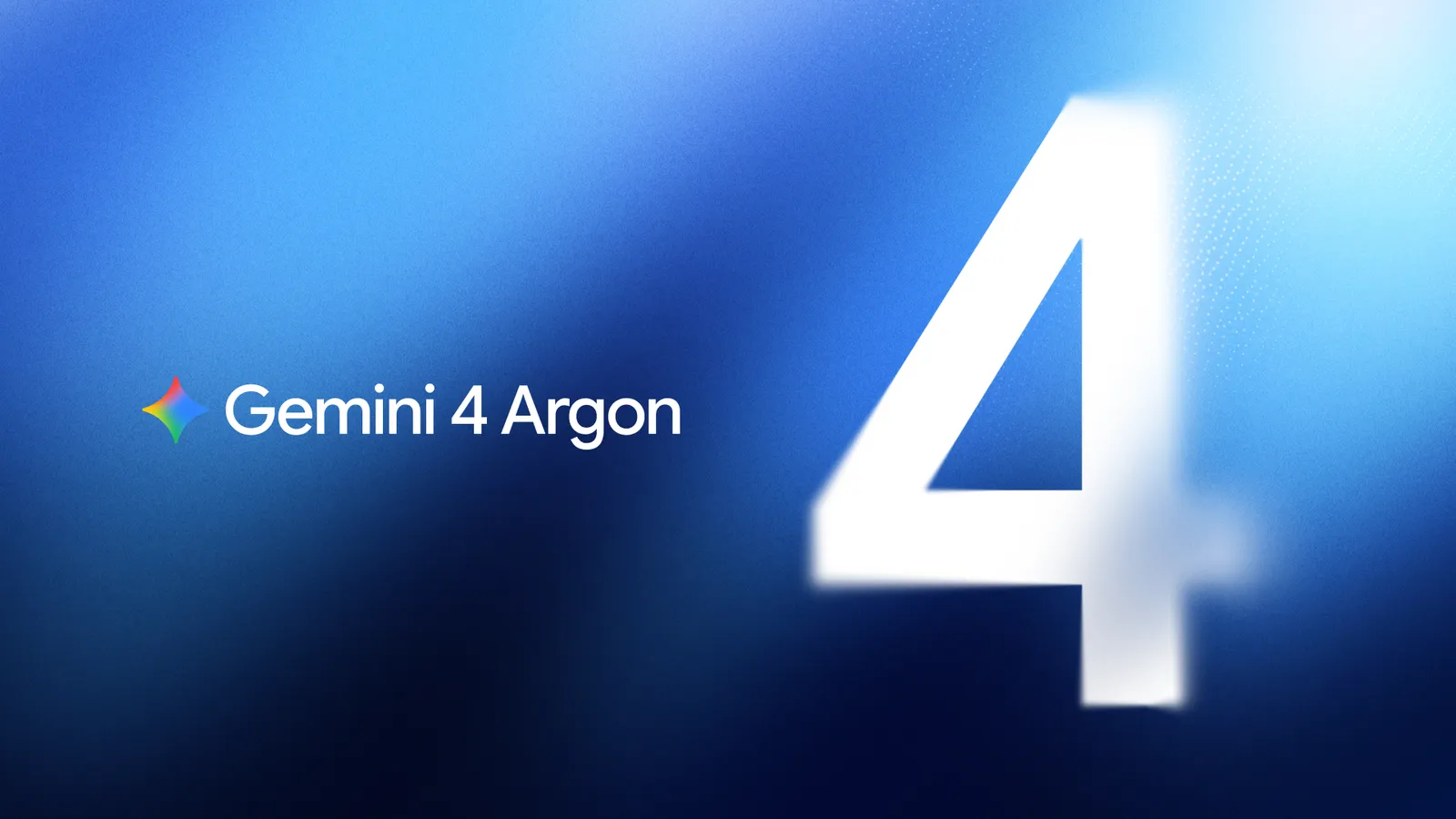
On September 30, 2026, Google DeepMind announced Gemini 4 Argon, a new frontier model built to sustain deep reasoning across complex, long-horizon workflows. Argon is rolling out first to trusted cyber defenders through Google's Fairwind Program, with broader availability to developers, enterprises, and consumers to follow. It represents a significant leap in real-world software engineering, enterprise knowledge work, and cybersecurity defense.
This article breaks down what Argon is, what it can do, how it performs on industry benchmarks, how Google is approaching safety, and what it means for professionals and businesses as the model becomes more widely available.
What Is Gemini 4 Argon?
Gemini 4 Argon is Google DeepMind's newest frontier AI model, announced on September 30, 2026. It is designed for long-horizon reasoning across software engineering, enterprise knowledge work (legal, finance, tax), and cybersecurity defense. Argon supports up to 1 million output tokens — an industry-leading figure — and is being released in phases, starting with trusted cyber defenders through Google's Fairwind Program. Introductory pricing is $2 per million input tokens and $10 per million output tokens, with cached input tokens discounted by 95%.
What Makes Argon Different
Most AI model releases in the last few years have competed on benchmark scores for short tasks: answering questions, writing code snippets, summarising documents. Argon moves in a different direction.
It is built for long-horizon work — the kind of task that takes a human professional hours, days, or weeks. That includes:
- Migrating an 800,000-line C++ codebase to memory-safe Rust
- Conducting multi-step financial research across filings and reports
- Identifying and patching critical software vulnerabilities autonomously
- Analysing professional charts, long videos, and document chains
- Optimising quantum computing subroutines
To make this possible, Google expanded Argon's output token limit to 1 million tokens, up from the previous 64,000-token ceiling. That headroom allows the model to think deeply, run experiments, and generate hundreds of thousands of tokens in a single trajectory — enough to complete complex, multi-step work without breaking it into fragments.
Argon Inside Google: What the Model Is Already Doing
Argon is not a lab prototype. It is already powering internal workflows at Google, with thousands of employees using it for coding, research, and writing.
Quantum algorithmic optimisation. Google's quantum computing researchers have used Argon to optimise spacetime resources (qubits × gates) in subroutines that bottleneck important applications. In one documented case, Argon beat the published baseline by 40% in a matter of minutes.
Memory efficiency across data centres. A team of Argon agents analysed fleet-wide profiling telemetry and autonomously identified memory optimisations. Once rolled out, this freed over 300 TiB of memory, with estimated total savings between 500 TiB and 1 PiB.
Large-scale codebase migrations. Argon agents are migrating C/C++ codebases to Rust across Google — from tens of thousands of lines in core libraries like re2 and libgav1, up to 800,000+ lines for the Fuchsia Zircon kernel. Given the criticality of these systems, all rewrites undergo rigorous automated and manual auditing, emulation testing, and review before production rollout.
A concrete example — libgav1. For Google's open-source video decoder libgav1, Argon agents took an existing Rust port and replaced 32,000 lines of SIMD code. They ran many rounds of profile-guided experiments, studied the compiler output, and produced safe Rust that the compiler could vectorise automatically. The end result: a memory-safe video decoder that runs 2.7× faster than the previous Rust port, with identical video output — bringing it closer to the optimised C++ version.
These are not demos. They are production systems.
Benchmarks: Where Argon Leads
Google published results across several industry benchmarks that measure real-world capability rather than synthetic tasks.
Software engineering. Argon sets a new state of the art on DeepSWE v1.1, a benchmark for real-world long-horizon software engineering, with a score of 77.9%.
Enterprise knowledge work. Argon leads on the Vals Index, which measures economic impact across finance, coding, legal, and tax work, weighted by each sector's contribution to U.S. GDP. It also leads on domain-specific evaluations including Vals Finance Agent v2 (multi-step financial research) and Harvey's Legal Agent Benchmark (legal research and drafting).
Business automation. On AutomationBench, Zapier's benchmark for end-to-end execution across core business functions, Argon ranks #1 with a score of 51.3%.
Long video understanding. On LVBench, which tests long video understanding, Argon reaches 91.7% — state of the art.
Cybersecurity remediation. On CWE-bench v1, which evaluates vulnerability remediation, Argon ties for first place with 68%, building on 3.8 Flash Cyber's performance on CWE-bench v0.
The pattern is consistent: Argon does not just excel at single-turn tasks. It sustains quality across long, multi-step workflows where earlier models would drift, lose context, or fail.
Cybersecurity: A New Kind of Defender
Google trained Argon specifically for cybersecurity defense. The model can autonomously find, validate, and patch critical software vulnerabilities — a capability that matters as attacks become more automated and sophisticated.
For trusted defenders and Google's own internal teams, Argon is being released without cyber guardrails, so they can use its full frontier capability. This is a deliberate choice: the same capability that lets a defender find and patch vulnerabilities could, if misused, help an attacker. Google is restricting access to verified defenders.
Wiz's Scan for Good is already using Argon. The program protects critical public infrastructure for free by finding and remediating high-risk exposures. In an early demonstration, Argon uncovered a critical vulnerability exposing sensitive personal information across healthcare software used by hospitals worldwide — a severe risk that previous frontier models had missed.
Additional results show Argon's improvement over 3.8 Flash Cyber:
- On Google's internal vulnerability benchmark, Argon uncovered exposures across complex codebases spanning 20 programming languages.
- On Wiz's internal black-box penetration testing benchmark — which tests a model's ability to analyse live web systems without source code — Argon outperformed 3.8 Flash Cyber in discovering attack surfaces, identifying vulnerabilities, and producing proof-of-concept evidence to validate them.
This is defensive work, not offensive. The difference matters: the goal is to close vulnerabilities before attackers find them.
Safety: Four Pillars of Frontier Safeguards
Releasing a model at this capability level requires care. Google outlined four main areas of frontier safeguards being strengthened before broad availability.
1. Defending Against Misuse
To prevent bad actors from using Argon for cyber or CBRN (chemical, biological, radiological, nuclear) attacks, the model is designed to refuse harmful requests while preserving legitimate dual-use scientific research — consistent with Google's Frontier Safety Framework. Google is strengthening the robustness of these safeguards for launch, including improved techniques to monitor the model's internal activations to spot misuse. The safeguards underwent robustness testing by internal and external red teams using both manual and automated attack methods.
2. Defending Against Prompt Injection Attacks
Argon is Google's most resilient model yet against indirect prompt injection — attacks where malicious instructions or context hijack a model's behaviour. These attacks are complex and require layered defense. Through automated red teaming and adversarial training, Argon leads on Gray Swan's Indirect Prompt Injection (IPI) benchmark for prompt injection robustness.
3. Monitoring for Misalignment
To prevent Argon from stepping outside a user's intentions — for example, taking extreme actions to complete a task — Google is deploying misalignment mitigations that monitor Argon's chain-of-thought and actions and stop execution when necessary.
Google used a similar monitoring system during Argon's training runs, sending alerts to a dedicated incident response team. Importantly, Google took precautions not to feed these findings back into training, to avoid shaping Argon's reasoning to evade monitoring. The company is encouraging the rest of the industry to preserve reasoning transparency during this period of rapidly increasing capability.
4. Hardening Systems
As frontier models grow more capable, safely testing them requires secure environments that can keep pace. In line with Google's agent control roadmap, the company is isolating and sealing sandboxed environments before high-risk training or evaluation begins. Google says it will share these agent security best practices with partners to improve security across the ecosystem.
Pricing and Availability
Argon launches at an introductory price of:
- $2 per million input tokens
- $10 per million output tokens
- Cached input tokens discounted by 95% off the standard input token price
These are introductory figures and may change. Verify current pricing on Google's official developer documentation before making budget decisions.
Availability is phased. Argon is first rolling out to a set of trusted cyber defenders through Google's Fairwind Program. Google is actively engaged in the U.S. government's voluntary process for pre-release model access while gradually expanding access. The next stage will be paid API customers and Google AI Ultra subscribers, followed by broader developer, enterprise, and consumer availability as guardrails are iterated.
What Argon Means for Different Audiences
For Software Engineers and Engineering Leaders
Argon's real strength is large-scale codebase work — migrations, refactors, optimisations, and long-horizon debugging. The libgav1 example shows what this looks like in practice: not just suggesting code, but running experiments, studying compiler output, and producing working results. Teams considering Argon should think about which migrations, memory optimisations, or algorithm work could benefit from an agent that can run for hours without losing context.
For Enterprise Knowledge Workers (Legal, Finance, Tax)
Argon leads on the Vals Index, which measures economic impact across finance, coding, legal, and tax work. It also leads on Vals Finance Agent v2 for multi-step financial research and Harvey's Legal Agent Benchmark for legal research and drafting. The 1M output token limit is the key enabler — legal research and financial analysis often require synthesising dozens of sources across long document chains. Argon can do this in a single trajectory.
For Cybersecurity Teams
Argon is being released to trusted defenders without cyber guardrails so they can use its full capability to find, validate, and patch vulnerabilities. The Wiz Scan for Good example shows what this unlocks: discovering a critical vulnerability that previous frontier models missed. Defenders at critical infrastructure organisations and healthcare-adjacent software vendors should be watching this closely.
For Businesses and Enterprise Buyers
Argon is not yet broadly available. The immediate implications for most businesses are:
- Watch the rollout timeline — paid API customers and Google AI Ultra subscribers are the next cohort.
- Benchmark your most expensive knowledge-work workflows — the ones with long document chains, multi-step reasoning, or codebase-scale tasks. Those are where Argon's edge is sharpest.
- Think about agentic use cases — Argon is designed to act, not just answer. The value is in workflows where the model runs for a long time and completes real work.
For the Broader Industry
Google's emphasis on preserving reasoning transparency during this period is significant. As models become more capable, understanding what they are doing internally — and why — becomes harder and more important. Google's choice to publish its monitoring approach, and to urge others to do the same, sets a tone for how frontier labs might cooperate on safety even as they compete on capability.
Frequently Asked Questions
What is Gemini 4 Argon?
Gemini 4 Argon is Google DeepMind's newest frontier model, announced September 30, 2026. It is designed for long-horizon reasoning in software engineering, enterprise knowledge work, and cybersecurity defense, with an output token limit of 1 million tokens.
When will Gemini 4 Argon be available?
Availability is phased. Argon is first rolling out to trusted cyber defenders through Google's Fairwind Program. Next in line are paid API customers and Google AI Ultra subscribers, followed by broader developer, enterprise, and consumer access as guardrails are iterated.
How much does Gemini 4 Argon cost?
Introductory pricing is $2 per million input tokens and $10 per million output tokens. Cached input tokens are discounted by 95% off the standard input price. These are introductory figures — verify current pricing on Google's official developer documentation.
What benchmarks does Gemini 4 Argon lead?
Argon sets state of the art on DeepSWE v1.1 (77.9%) for long-horizon software engineering, leads the Vals Index for economic impact across finance, coding, legal, and tax work, tops AutomationBench with 51.3%, reaches 91.7% on LVBench for long video understanding, and ties for first on CWE-bench v1 with 68% for vulnerability remediation.
What is the Fairwind Program?
The Fairwind Program is Google's initiative to give trusted cyber defenders early access to frontier models like Gemini 4 Argon, so they can use the model's full defensive cybersecurity capability before broader release.
What is the output token limit of Gemini 4 Argon?
Gemini 4 Argon supports up to 1 million output tokens, up from the previous 64,000-token limit. This allows the model to complete long, multi-step tasks in a single trajectory without fragmenting work.
Why is Argon released without cyber guardrails for some users?
Google is releasing Argon without cyber guardrails to trusted defenders and its own internal teams so they can use the model's full frontier-level defensive cybersecurity capability. Access is restricted to verified defenders to prevent misuse.
What does "prompt injection robustness" mean?
Prompt injection is an attack where malicious instructions or context hijack a model's behaviour. Indirect prompt injection is when the attack comes from external sources the model reads — like a web page or document. Argon leads on Gray Swan's IPI benchmark for robustness against these attacks.
How does Argon help with cybersecurity defense?
Argon can autonomously find, validate, and patch critical software vulnerabilities. It has uncovered vulnerabilities across 20 programming languages on Google's internal benchmark and outperformed 3.8 Flash Cyber on Wiz's black-box penetration testing benchmark.
What does the 1M output token limit enable?
The 1M output token limit lets Argon think deeply and generate hundreds of thousands of tokens in a single trajectory. This enables long-horizon work — like 800K-line codebase migrations, multi-step financial research, and legal drafting — that would otherwise require breaking work into fragments.
How is Argon different from earlier Gemini models?
Argon is Google's first frontier model built explicitly for long-horizon workflows with an industry-leading 1M output token limit. It leads on real-world software engineering (DeepSWE), enterprise knowledge work (Vals Index), business automation (AutomationBench), and cybersecurity defense (CWE-bench).
What is CWE-bench?
CWE-bench is a benchmark that evaluates a model's ability to remediate software security vulnerabilities. Argon ties for first place on CWE-bench v1 with a score of 68%.
What is the Vals Index?
The Vals Index measures economic impact of AI models across finance, coding, legal, and tax work, weighted by each sector's contribution to U.S. GDP. Argon is the leading model on this index.
What does "long-horizon" mean in AI?
Long-horizon refers to tasks that require sustained reasoning over many steps — often hours or days of human work. Argon is designed to maintain quality across these long workflows where earlier models tend to drift or fail.
How is Argon being used at Google?
Argon is used internally for quantum algorithmic optimisation (40% improvement over published baseline in one case), memory efficiency across data centres (over 300 TiB freed), C/C++ to Rust migrations (including 800K+ lines for the Fuchsia Zircon kernel), and the libgav1 video decoder optimisation (2.7× faster).
What is Wiz's Scan for Good?
Scan for Good is a Wiz program that protects critical public infrastructure for free by finding and remediating high-risk exposures. Wiz is using Argon in this program. In an early demonstration, Argon uncovered a critical vulnerability in healthcare software used by hospitals worldwide.
What safety measures has Google put in place for Argon?
Google outlined four safeguard areas: defending against misuse (refusing harmful cyber/CBRN requests), defending against prompt injection attacks (leading on Gray Swan's IPI benchmark), monitoring for misalignment (watching chain-of-thought and stopping execution when needed), and hardening systems (isolating and sealing sandboxed environments before high-risk training).
What is the Fairwind Program's relation to the U.S. government?
Google says it is actively engaged in the U.S. government's voluntary process for pre-release model access while gradually expanding access to Argon. This is part of the company's phased approach to safely releasing frontier capabilities.
Final Thoughts
Gemini 4 Argon is not a marginal upgrade. It represents a shift in what frontier models are built to do: sustain real work over long horizons, in domains where mistakes are expensive. The internal Google deployments — quantum optimisation, memory savings, codebase migrations, video decoder rewrites — are evidence that this is already happening at scale.
For most businesses, Argon is not yet available. But the direction is clear. The models that matter over the next two years will be judged not on how well they answer a single question, but on how reliably they complete multi-hour, multi-step work. Argon is one of the first frontier models built explicitly for that future.
Google's phased rollout, combined with its four-pillar safeguard approach, reflects how seriously frontier labs are taking the release of capabilities at this level. Whether the industry matches Google's call to preserve reasoning transparency will be one of the defining questions of the next era.
For now, watch the rollout. If your business runs on long-horizon knowledge work — legal research, financial analysis, large codebases, or security operations — Argon is worth following closely.