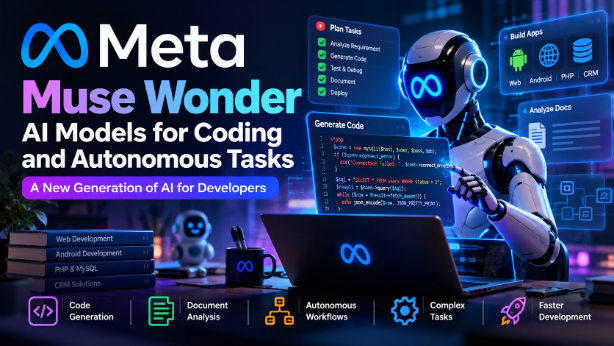
Meta has officially entered the frontier AI race with Muse Wonder and Muse Wonder Full, announced on October 12, 2026 . These models represent Meta’s most capable AI systems to date, purpose-built for what the company calls “personal and professional agentic tasks” . The launch marks a significant strategic shift: after fourteen months of rebuilding its AI foundations, Meta is now competing directly with OpenAI, Anthropic, and Google at the highest level of model performance .
Key Facts at a Glance:
- Announcement Date: October 12, 2026
- Models Released: Muse Wonder (API-accessible) and Muse Wonder Full (Muse Code subscribers only)
- Primary Use Cases: Coding, document analysis, multi-step agentic workflows
- Context Window: 1 million tokens for both models
- API Pricing (Muse Wonder): $4 per million input tokens, $20 per million output tokens
- Key Features: Active Memory (cross-conversation context retention) and Active Focus (long-horizon task persistence)
What Are Meta Muse Wonder and Muse Wonder Full?
Muse Wonder and Muse Wonder Full are large language models developed by Meta’s Superintelligence Lab, representing the company’s first serious attempt at building a “frontier” model—an AI system capable of competing with the best offerings from OpenAI, Anthropic, and Google . Built on the foundations established by the earlier Muse Spark models, the Wonder series is designed specifically for agentic tasks: jobs that require sustained, multi-step reasoning and execution rather than simple question-and-answer interactions .
Meta describes the models as being trained for “expert domains including law, finance, and health, along with frontier coding performance” . The company positions these models not as general-purpose chatbots but as engines for autonomous agents—systems that can work through complex problems, persist through difficulties, and complete meaningful work with minimal human intervention.
The two models differ primarily in capability and access. Muse Wonder is the developer-facing version, available through the Meta Model API and the Muse Code coding environment. Muse Wonder Full is the more powerful variant, restricted to Muse Code subscribers who pay for premium tiers . This tiered approach mirrors strategies used by competitors, though Meta has taken the unusual step of withholding its most capable model from standard API access entirely .
Key Features of Meta’s Muse Wonder AI Models
The Muse Wonder series introduces two capabilities that Meta believes are essential for effective AI agents: Active Memory and Active Focus .
Active Memory allows the models to carry context across conversations. Rather than starting fresh with each new interaction, the model retains important details about the user and the task at hand, retrieving relevant information when it becomes useful . Meta’s Chief AI Officer Alexandr Wang described this capability as crucial: “Memory is incredibly important for personal agents, and it means that it carries what matters about you across conversations over days, weeks, months, so that nobody is re-explaining themselves every time” .
Active Focus addresses the problem of long-running tasks that encounter obstacles. When a conventional AI system hits a roadblock, it may simply fail or produce a degraded response. Muse Wonder, according to Meta, will “keep working toward your goal when a task gets hard, try other approaches, recover from errors, and follow through, asking for clarification when needed and checking in before following through on anything important” . This persistence is what distinguishes an agent from a simple chatbot.
Both models support a 1 million token context window, unchanged from the previous generation . This capacity allows them to process lengthy documents, extensive codebases, and prolonged conversations without losing critical context. The models can understand text, images, audio, and video as inputs, though they generate text-only responses .
Meta trained the models at its gigawatt-scale Prometheus data center, using improved pretraining and reinforcement learning methods . The company claims Muse Wonder is its “most aligned model to date,” with safety training designed to prevent sharing private information without permission, refuse harmful requests, and strengthen cybersecurity defenses .
Muse Wonder vs Muse Wonder Full
The primary distinction between the two models lies in performance and access. Independent benchmarking organization Artificial Analysis reported that Muse Wonder achieved an Intelligence Index score of 52, while Muse Wonder Full scored 56 at maximum reasoning effort . For context, this places Muse Wonder Full in the top three globally on six of ten evaluations and particularly strong in agentic knowledge work and scientific reasoning .
On agentic benchmarks, the gap widens. Muse Wonder Full scored 57% on Terminal-Bench 4.0 compared to Muse Wonder’s 52% . On GDPval-AA, which measures professional knowledge work, Full scored 1857 Elo versus Wonder’s 1857—a near-tie that suggests the standard model remains highly capable .
Access differs dramatically. Muse Wonder is available through the Meta Model API at $4 per million input tokens and $20 per million output tokens . Muse Wonder Full is not offered through the API at all . It is available only through Muse Code subscriptions: the $50/month “Power Usage” tier and the $200/month “Maximum Usage” tier .
This restriction has significant implications for enterprises. As VentureBeat noted, “Businesses can test Wonder Full within Meta’s coding environment, but cannot yet deploy it through the standard Meta Model API” . For organizations seeking to embed the most capable model in production systems, this is a material limitation.
Neither model is open-weight. Unlike Meta’s smaller Muse Glimmer model, released under Apache 2.0, the Wonder series parameters are not publicly downloadable for self-hosting or private infrastructure deployment .
How Can Developers Use Muse Wonder for Coding?
Meta claims “frontier coding performance” for both models, and independent benchmarks support this to a degree . On the Artificial Analysis Coding Agents Index, Muse Wonder Full scored 68, tying with Claude Code using Sonnet 5.5 and surpassing Opus 5.5’s 66 . Muse Wonder scored 63—a significant improvement over Muse Spark 1.3’s 54 .
The following represent potential workflows based on reported capabilities, not guaranteed features:
Generating PHP APIs and MySQL queries. The models’ strong performance on long-horizon coding tasks suggests they can scaffold backend code, generate database schemas, and write CRUD operations. However, verification of output correctness and security remains essential—no benchmark guarantees bug-free or secure code.
Debugging Java-based Android applications. The agentic capabilities and 1 million token context window could enable analysis of stack traces, identification of potential issues across multiple files, and suggested fixes. Meta’s promotional materials mention “building a working app” as a target use case .
Building CRM features and automating repetitive development tasks. Muse Wonder Full’s performance on Terminal-Bench 4.0 (57%) and long-horizon tasks like SWE-Marathon (57.5%) suggests capability for multi-file refactoring and feature implementation . Results will vary by project complexity and codebase quality.
Reviewing code and explaining technical documentation. The large context window enables processing substantial codebases and documentation. Developers on X (formerly Twitter) have reported that Muse found security vulnerabilities missed by other agents, though such claims are anecdotal .
Prototyping web applications. Meta explicitly mentions “building a working app for a new business” as a target use case . The agentic features—Active Focus in particular—are designed for tasks that require sustained effort across multiple steps.
What Is Agentic AI and Why Does It Matter?
The distinction between a conventional AI chatbot and an AI agent is fundamental to understanding what Meta has built. A chatbot responds to individual queries, often following predetermined conversational patterns. It answers questions, generates text, and completes isolated tasks, but it does not maintain a persistent goal across interactions.
An AI agent, by contrast, is a goal-driven system that can reason about a problem, take actions, and adapt autonomously in pursuit of an objective . It plans multi-step workflows, uses tools or APIs where permitted, and maintains context to achieve a goal without requiring step-by-step human instructions. Meta’s Active Focus feature is explicitly designed for this: “keep working toward your goal when a task gets hard, try other approaches, recover from errors, and follow through” .
For software development, this distinction has practical consequences. An agent could potentially handle an entire feature implementation—understanding requirements, writing code across multiple files, running tests, interpreting failures, and iterating until the task is complete—rather than just answering isolated coding questions. This is the vision Meta is selling: not a faster autocomplete, but a junior developer that works autonomously.
Benefits for Startups, Agencies, and Small Businesses
The potential benefits of Muse Wonder for smaller organizations are substantial, though they come with caveats.
Accelerated prototyping. Meta’s benchmarking shows strong performance on ProgramBench, which asks an agent to rebuild a complete program from scratch, though Claude Opus 5.5 actually won this specific test (70.5% vs. 59%) . For startups, the ability to rapidly prototype features could shorten time-to-market.
Reduced time on repetitive tasks. Code generation, refactoring, and testing are areas where AI agents can provide leverage. Meta’s models are trained for “long-running tasks” and “maintain progress throughout the development process” .
Cost considerations. Muse Wonder’s API pricing ($4/$20 per million tokens) is competitive with GPT-6 Sol and Opus 5.5 . Artificial Analysis calculated a Cost per Task of $4.52 for Muse Wonder on its Intelligence Index—lower than Claude Fable 5.1 ($7.63) and Claude Opus 5.5 ($5.98), but higher than GPT-6 Astra ($3.26) and Gemini 4 Argon ($1.99) .
However, human oversight remains essential. Generated code must be reviewed for correctness, security vulnerabilities, and maintainability. The Contributor mode in Muse Code subscriptions defaults to permitting Meta to use submitted data for model training—a significant consideration for businesses handling proprietary code .
How to Test Muse Wonder in a Real Development Project
A disciplined evaluation framework is essential before relying on any AI coding tool. The following checklist provides a structured approach:
- Choose a small, well-defined coding task with clear success criteria. Avoid vague objectives like “build a feature”—instead, specify “implement a REST endpoint that accepts JSON input, validates it, and stores it in MySQL.”
- Establish a baseline using your existing development tool. This could be your current IDE, another AI assistant, or manual development. The goal is a comparison point.
- Run both tools against the same requirements. Use identical prompts, provide the same codebase context, and measure with consistent metrics.
- Test correctness, security, maintainability, and completeness. A generated function that works but contains SQL injection vulnerabilities is worse than useless. Review for common security issues, code style consistency, and edge case handling.
- Measure correction time and total cost. The time spent fixing AI-generated code must be counted. If an agent produces 100 lines of code in 30 seconds but requires 2 hours of debugging, the net benefit may be negative.
- Test edge cases and review generated code before deployment. Never push AI-generated code to production without human validation. This is non-negotiable.
Limitations and Security Considerations
Several important limitations require attention before adopting Muse Wonder for production work.
Muse Wonder Full is not available via API. This is the most significant practical constraint. Enterprises seeking to embed the most capable model in production systems cannot do so through standard API access . The model is available only through Muse Code’s interactive environment.
Contributor mode data usage. Muse Code subscriptions default to Contributor mode, which “permits Meta to use submitted prompts, code, files, contextual information and outputs to improve future models” . Subscribers can disable this, but the change applies only to future submissions. Meta’s terms explicitly prohibit submitting confidential, sensitive, or personal information while using Contributor services .
Zero data retention limitations. Meta offers zero data retention to qualified Model API organizations, but this arrangement “does not support server-side conversation state, background requests, file uploads or built-in web search” . These limitations directly impact the memory and long-running agent features that are central to Muse Wonder’s value proposition.
Hallucinations and incorrect assumptions. As with all large language models, Muse Wonder can generate plausible but incorrect code, make incorrect assumptions about requirements, or produce insecure implementations. Independent verification of Meta’s benchmarks remains limited—the company’s model card explicitly notes that its runs of competing models were “best-effort” and may not have been optimally tuned .
Safety evaluations pending. Meta has promised a “full safety report” but has not yet released it. The model card states that Meta “does not rule out Muse Wonder Full reaching the high-risk threshold for chemical and biological threats when it runs without mitigations” . This is a significant caveat.
Frequently Asked Questions
What is Meta Muse Wonder AI?
Muse Wonder is a frontier AI model released by Meta on October 12, 2026, designed for agentic tasks including coding, document analysis, and multi-step professional workflows . It is available through the Meta Model API and Muse Code, with API pricing at $4 per million input tokens and $20 per million output tokens .
What is Muse Wonder Full?
Muse Wonder Full is the more capable version of Muse Wonder, scoring 56 on the Artificial Analysis Intelligence Index versus Wonder’s 52 . It is available exclusively to Muse Code subscribers on $50/month or $200/month plans and is not available through the standard Meta Model API .
Are Meta Muse Wonder models available to developers?
Muse Wonder is available through the Meta Model API and Muse Code. Muse Wonder Full is only available through Muse Code subscriptions—not as a standalone API .
Can Muse Wonder write PHP code?
Meta claims “frontier coding performance,” and PHP is a supported language in most modern LLMs . However, no specific PHP benchmark or independent verification has been published. Testing against your own requirements is strongly recommended before relying on it for production code.
Can AI coding agents help build Android apps?
Meta’s announcement mentions “building a working app” as a use case, and Muse Wonder Full scored 68 on the Artificial Analysis Coding Agents Index . Java and Kotlin are standard languages for Android development and are within the capabilities of frontier models. However, verification of output correctness and security remains essential.
Are Muse Wonder models free?
No. Muse Wonder API pricing is $4 per million input tokens and $20 per million output tokens . Muse Wonder Full requires a $50 or $200 monthly Muse Code subscription . There is no free tier for either model.
How does agentic AI differ from traditional AI chatbots?
Chatbots respond to individual queries with predetermined conversational paths. AI agents pursue goals through multi-step reasoning and action, using tools and maintaining context to complete complex tasks autonomously . Meta’s Active Memory and Active Focus features are specifically designed to enable this agentic behavior .
Final Verdict
Meta’s Muse Wonder series represents a genuine step change in the company’s AI capabilities. Independent benchmarks confirm that Muse Wonder Full, in particular, is competitive with the best models from OpenAI and Anthropic . For developers, Muse Wonder offers API access at rates comparable to other frontier models, with strong performance on coding and agentic tasks .
However, significant limitations warrant caution. The most capable model—Muse Wonder Full—is unavailable through the API, restricting its use to Meta’s own coding environment . Data usage defaults in Muse Code subscriptions require careful attention for businesses handling proprietary code . And the full safety report promised by Meta has not yet been released .
For developers and businesses considering Muse Wonder, the recommendation is straightforward: evaluate real-world performance against your specific requirements. Use the testing checklist above. Do not rely solely on vendor benchmarks or promotional claims. The models merit serious consideration, but human code review and security validation remain non-negotiable.