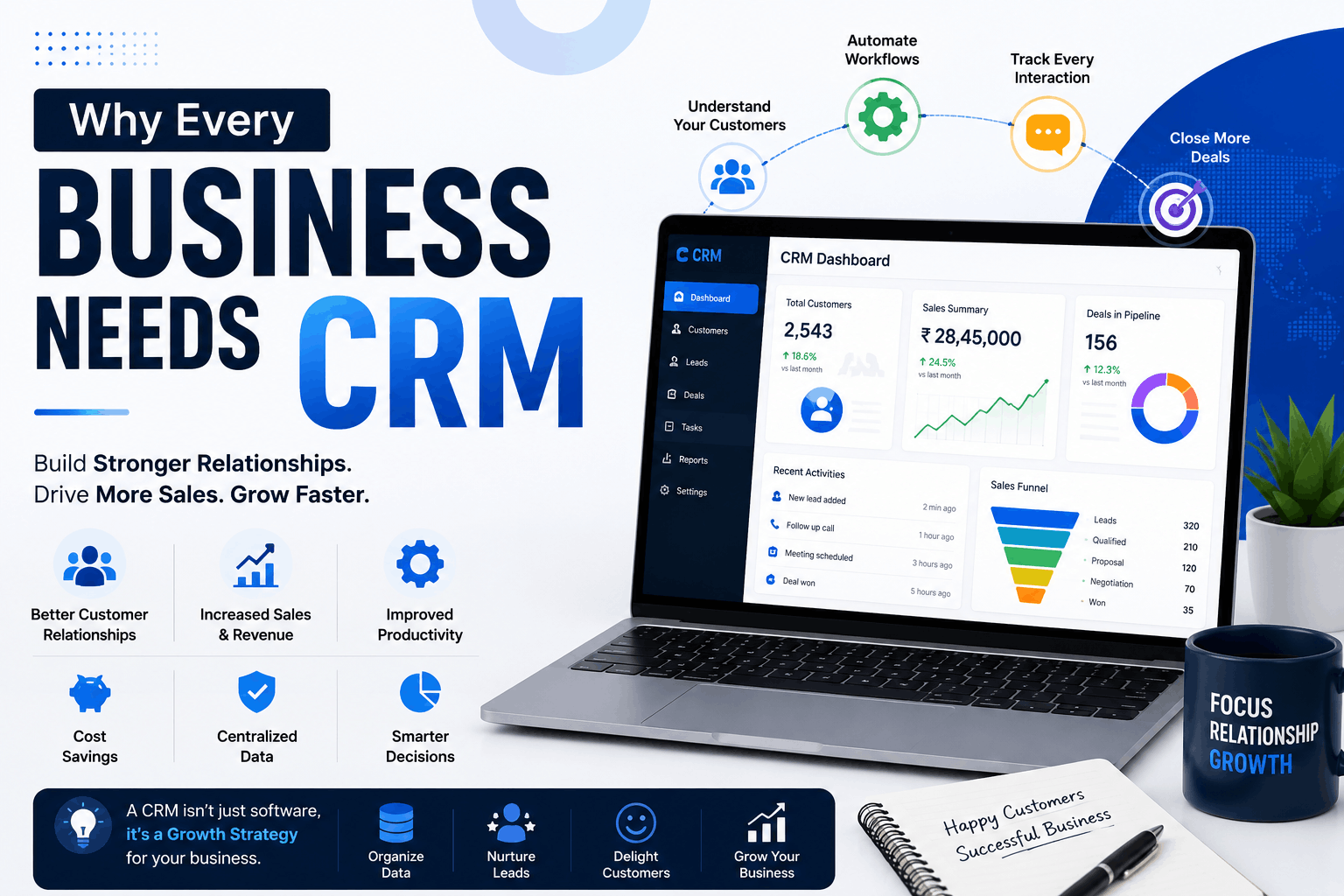
Walk into any successful retail chain, bank, or e-commerce company today, and you will find one thing in common behind the scenes: a system that remembers every customer. From the last product they browsed to the complaint they raised three months ago, this memory shapes how a business talks, sells, and serves. That system is Customer Relationship Management (CRM).
With the global CRM market projected to surpass $112 billion in 2025, the question is no longer whether companies need CRM but how deeply they choose to embed it into their strategy. For businesses seeking a solution that truly fits their unique workflows, custom CRM development offers advantages that off-the-shelf platforms simply cannot match .
What CRM Really Means for Your Business
At its core, CRM is a combination of strategy, processes, and technology that helps an organisation manage every interaction with current and prospective customers. It is not just a fancy address book or a sales dashboard. A good CRM system collects, organises, and analyses customer information across the entire buyer journey—from the first website visit to post-purchase service requests.
Think of a mid-sized apparel brand that sells through its own stores, a website, Instagram, and a few marketplaces. Without CRM, the store manager, the social media intern, the website team, and the customer care executive all see a different version of the same customer. With CRM, they see one unified profile, with one history, one set of preferences, and one ongoing conversation.
That single shift is the foundation on which everything else in this article rests.
The Old Way: Spreadsheets Create More Problems Than They Solve
Many small and mid-sized businesses still use separate tools—one spreadsheet for leads, another for orders, and support logs scattered elsewhere. This may work when a business is very small, but everything breaks as soon as it starts scaling.
As the customer base grows:
- Data becomes scattered and inconsistent
- Sales numbers don't match inventory counts
- Support logs live in isolated systems
- Customer history becomes hard to track
- Reports take too long and often contain errors
Monthly reporting turns into a painful task. Teams waste hours doing manual work—data entry, follow-ups, reminders—pulling them away from important tasks. Miscommunication grows between departments. Leads slip away. Service levels fall.
Without a unified system, growth slows down and customer satisfaction drops.
Why Every Business Needs CRM: The Core Benefits
1. Strengthening Customer Relationships Across Every Channel
Modern customers don't interact with a brand on just one platform. They might discover a product on Instagram, compare prices on the website, ask a question on WhatsApp, buy it at a physical outlet, and later raise a service request through email.
Creating a Single, Consistent Conversation
When all interactions are logged in one place, every team member who speaks to the customer already knows the context. The sales executive knows what the customer previously bought, the support agent knows what was promised, and the marketing team knows what kind of offers will actually be relevant.
Research shows that 79% of customers expect a consistent experience across all channels, which makes the CRM act as a central hub unifying all interactions.
Building Loyalty Through Personalisation
Once a business has rich customer data, it can move from generic broadcasts to personalised conversations. Birthday discounts, product recommendations based on past purchases, reminders for refills, and targeted offers for high-value customers all become possible.
The impact is measurable:
- Companies using CRM tools see a 27% increase in customer retention
- Personalised email campaigns based on CRM data have a 14% higher click-through rate than non-personalised ones
- In a market where acquiring a new customer can cost five to seven times more than retaining an existing one, this kind of relationship strengthening is not optional—it is the engine of profitability
Reducing the Risk of Customer Churn
CRM systems also act as an early warning system. They can flag accounts with low activity, missed check-ins, or upcoming renewal dates, helping teams reach out before a customer quietly walks away. For subscription businesses, telecom operators, and SaaS companies, this proactive monitoring is often the difference between a healthy revenue stream and a leaky bucket.
2. Driving Operational Efficiency Through Centralised Data
The second big reason every business needs CRM is operational. Behind every happy customer is a team that has access to the right information at the right time.
Ending the Chaos of Scattered Information
In organisations without a CRM, customer data tends to be scattered across emails, notepads, WhatsApp messages, and individual employee laptops. The moment a salesperson resigns, half the relationship history walks out with them.
A CRM solves this by consolidating all customer information into a single database that is accessible to every authorised team member. Data silos disappear, and the entire company appears as one cohesive unit to the customer.
Automating Routine Work
Data entry, follow-up reminders, lead assignment, ticket routing, and even basic responses to customer queries can all be automated through a CRM. This is not just a convenience—it is a productivity multiplier.
- Sales teams typically save four to five hours per week by eliminating manual data entry and duplicate work
- CRM automation reduces administrative tasks by up to 80%, allowing reps to spend more time selling
- Research shows businesses save 5 to 10 standard work hours per week using CRM tools
For a growing startup or an MSME, this is the equivalent of adding extra staff without the extra payroll.
Smarter Decisions Through Analytics
Once data is centralised, it becomes a goldmine for analysis. CRM dashboards can reveal:
- Which products sell best in which regions
- Which marketing campaigns actually convert
- Which customers are most profitable
- Which sales reps need more support
Decisions stop being based on gut feel and start being based on evidence.
3. Shifting from Product-Centric to Customer-Centric Strategy
Perhaps the biggest contribution of CRM to long-term growth is strategic. For decades, businesses were built around products: design a good product, push it through distribution, and chase volume. CRM enables a fundamental shift—putting the customer at the centre of every business decision.
Today's buyers have more choices, more information, and shorter patience than any previous generation. They compare brands within seconds and switch loyalties just as fast.
Forrester research finds that organisations with a heavy focus on their customers have 51% higher retention rates, along with faster revenue and profit growth. CRM is the tool that operationalises this customer focus, giving every team a structured way to listen, respond, and improve.
The Custom CRM Advantage: Why EvolCRM Builds for Your Business
While off-the-shelf CRM platforms like Salesforce and HubSpot cover a significant portion of the market, they come with a fundamental limitation: they are built for the average business, not yours . 43% of businesses use less than half of their CRM features, paying for tools they don't need while missing the ones they do . The result is a team that works around the CRM instead of with it.
The Real Distinction: Custom vs. Platform Customization
Custom CRM development and platform customization are architecturally distinct. Platform customization means building on top of Salesforce or HubSpot's object schema using their native tools. Your CRM data model remains locked within the provider's solutions. When your entity relationships don't fit—say, a many-to-many between service contracts and multiple customer accounts, or a non-standard sales pipeline with regulatory checkpoints—you bend your business logic to match their schema, not the other way around .
Custom CRM software development starts from a blank data model. You design the entity relationships first, then build the application layer on top. An API-first architecture means every function—pipeline automation, reporting, document generation—is a discrete service callable via REST endpoints. No inherited constraints from a unified platform's opinionated object model .
The practical line: if you're writing Apex triggers in Salesforce to work around object limits, or chaining HubSpot workflows four layers deep to approximate a single business rule, you're paying platform-customization tax on a problem that a custom CRM system would handle in a single service .
Why EvolCRM Delivers the Custom Advantage
EvolCRM specializes in building custom CRM solutions that are designed from the ground up to match your exact business requirements. We understand that every business has unique workflows, and our custom development process ensures your CRM fits your business, not the other way around.
What EvolCRM Custom Builds Deliver:
CapabilityCustom CRM AdvantageExact Data Model FitEntity relationships designed around your business logic, not platform constraints Total Cost of OwnershipNo per-seat licensing fees that compound as you grow Data OwnershipYour data stays in your control, in your preferred infrastructure No Vendor Lock-inFreedom to evolve your CRM without waiting on a vendor roadmap Scalable ArchitectureMicroservices, cloud-native design that grows with your businessEnterprise SecurityEncryption, authentication, and compliance-ready (GDPR, SOC2)Seamless IntegrationsConnect with CRMs, ERPs, payment gateways, and third-party APIs
The Financial Case for Custom CRM
A custom CRM build becomes the financially rational choice when per-seat licensing costs exceed the annualized build-and-maintain cost. Salesforce Sales Cloud Professional costs $75 USD per user, per month, while HubSpot Sales Hub Professional is $90 per seat per month . Multiply by headcount, add mandatory add-ons (CPQ, advanced reporting, API call volume overages), and project three years forward. That three-year total cost of ownership figure is your build budget ceiling .
At 200+ seats, Salesforce's published list price for Sales Cloud Enterprise in 2026 is $175 per user per month, billed annually—$2,100 per seat per year . Across a growing organization, this regularly exceeds a custom CRM's five-year infrastructure and maintenance spend .
The AI-Powered Evolution of CRM
EvolCRM is at the forefront of the AI revolution in CRM. The platform brings together authentication, CRM, AI agents, agent processing, bot pipelines, and a modern frontend into a unified, self-hostable stack . Our AI-powered CRM solutions include:
- Intelligent Automation: Automate workflows, lead scoring, and follow-ups
- Predictive Analytics: Identify risks of churn and suggest next steps
- AI Agent Execution: Deploy agents that qualify prospects and update pipelines automatically
- Bot Pipeline Processing: Automate routine customer interactions
A Practical Example: When an inbound lead arrives through website chat, an AI agent can engage the customer immediately, capture interaction details, assign a lead score, schedule a meeting, generate follow-up emails, and recommend next steps for the sales representative—while simultaneously updating pipeline forecasts inside the CRM.
What previously required multiple employee touchpoints and several disconnected tools can now happen through a centralized AI-powered workflow.
When a Custom CRM Makes Sense for Your Business
Two signals consistently indicate a custom CRM is the right direction :
- Headcount trajectory: If your team is projected to cross 50-150 users within 18 months, start the custom CRM development conversation now
- Process divergence: If your sales pipeline automation, customer data model, or role-based access control requirements need more than three workarounds in the platform's native configuration, the ongoing consulting and admin overhead erodes the subscription's cost advantage
The Research Behind CRM's Impact
What the Studies Show
A 2025 peer-reviewed study published in the Sustainability journal studied employees across 228 SMBs and covered the impact of CRM on small businesses. With 9 hypotheses in mind, the study found 8 of them to be true.
Out of all the 8 proven hypotheses, systematic CRM organisation (the way customer data is organised in a CRM system) was found to have the highest impact on performance. The study also confirmed that CRM usage:
- Promotes customer loyalty
- Increases customer lifetime value
- Improves competitive advantage in the dynamic marketplace
A different study published in the International Journal of Progressive Research in Engineering Management and Science (IJPREMS) in 2025 surveyed small business owners from retail, healthcare, education, and service sectors. The research confirmed that the adoption of CRM systems by SMBs leads to a 20% to 30% improvement in effectiveness, particularly in customer retention and service quality.
The ROI of CRM
The financial case for CRM has become hard to ignore:
- When properly implemented, the ROI of a CRM software system can exceed 245%
- Companies using CRM are 86% more likely to meet sales targets compared to companies without CRM
- Nucleus Research found that a CRM system delivers an average return of $3.10 for every dollar invested
- The majority of companies that adopted a CRM recorded a sales revenue increase of 21% to 30% and a sales cycle reduction of 8 to 14 days
Does Every Business Really Need CRM?
The Case for Small Businesses
Small businesses (those with less than 500 employees) make up 99% of businesses and employ almost half of the workforce. Unfortunately, most rely on outdated systems like spreadsheets for managing customer relationships.
The Gap That Hurts SMBs
Metrigy's CX MetriCast 2025 study found that only 52.5% of companies with fewer than 250 employees have employed a CRM system. In comparison, 78.4% of companies with between 1,000 and 2,500 employees use a CRM. That gap shows which businesses have built systems to cultivate customer relationships and which have not.
When one employee holds vital customer information in their email, staff turnover can ultimately disrupt customer relationships that have been built over a long period of time.
Real-World Success Story
Brother's Leather Supply, a small leather goods manufacturer, managed wholesale inquiries, email, and vendor communications with spreadsheets. Once web orders hit the company, the system became overloaded.
The company was losing out on revenue because there were so many unfulfilled orders—all due to broken and lost opportunities for sales calls and follow-ups.
Transitioning to a CRM system helped the company decrease operational friction and manage workflows to the point that they reported consistent growth of 40% every month and hit six figures in sales.
CRM for Micro-Businesses and Solo Workers
Even in a micro-business, or for solo workers who don't need to collaborate, a CRM system can be a powerful tool. It eliminates the need to keep notes in paper or digital files, serving as a rich, searchable knowledge-management system. It can help track both new prospects and late payers, and you can even use it to host online sales and customer services.
The AI Revolution: CRM in 2026 and Beyond
CRM Is Becoming the System That Holds Everything Together
At the NRF 2026 conference, a clear signal emerged from the show floor: CRM is no longer viewed as a downstream campaign tool.
Many brands now operate across POS systems, eCommerce platforms, loyalty programs, and multiple marketing tools. As digital touchpoints grow, customer data becomes fragmented quickly. As a result, CRM is increasingly expected to act as the system that holds everything together—unifying fragmented data, identifying meaningful behavioural signals, and enabling personalisation earlier in the customer journey.
AI-Enhanced CRM: From Passive Records to Active Orchestration
AI has already enhanced CRM platforms through features such as predictive scoring, segmentation optimisation, and service routing—which still primarily augment human decision-making rather than act autonomously.
Agentic AI has recently emerged to take this trend one step further, enabling systems to plan and execute actions within certain parameters. These advancements are moving CRM from passive record-keeping toward active orchestration of revenue and customer engagement processes.
AI Agents Are Becoming Digital Employees
One of the biggest changes happening inside CRM platforms is the rise of AI agents functioning as digital employees rather than isolated automation tools. Businesses can now deploy workflows that respond to inbound leads instantly, qualify prospects based on intent signals, generate summaries, schedule follow-ups, recommend next actions, and update sales pipelines automatically.
A Practical Example
When an inbound lead arrives through website chat, an AI agent can engage the customer immediately, capture interaction details, assign a lead score, schedule a meeting, generate follow-up emails, and recommend next steps for the sales representative—while simultaneously updating pipeline forecasts inside the CRM.
What previously required multiple employee touchpoints and several disconnected tools can now happen through a centralised AI-powered workflow.
The Warning: Don't Get Left Behind
Through 2027, more than half of enterprises will not be able to deploy the latest AI technology for sales, customer service, and partner relationships because their processes and system designs are outdated, ISG predicts. This may limit revenue growth.
Companies choosing CRM software should consider the provider's AI strategy, architectural flexibility, and ecosystem maturity in addition to functionality.
What CRM Features Matter Most?
For small and mid-sized businesses, the features that deliver the most value are:
FeatureWhy It MattersContact ManagementCentralises all customer data in one placePipeline TrackingProvides visibility into every deal stageEmail IntegrationKeeps all communication in contextAutomated Follow-upsEnsures no lead falls through the cracksReporting DashboardsEnables data-driven decision-makingAI-Powered InsightsPredicts churn, suggests next steps, automates analysis
Ease of adoption matters just as much as feature depth. The best CRM for a small business is one that the team will actually use consistently.
Getting Started with EvolCRM Custom CRM Development
The EvolCRM Custom Development Process
EvolCRM follows a proven five-phase process to deliver custom CRM solutions that fit your business:
Phase 1: Discovery (Weeks 1-4) — We start by understanding your business goals, user needs, and technical requirements. This phase produces the CRM data model, not a prototype. We map entity relationships (contacts, accounts, deals, activities), define role-based access control tiers, and document integration touchpoints .
Phase 2: Architecture Decision and Sprint Planning (Weeks 3-5) — We resolve the architecture question: monolith vs. modular, API-first vs. embedded. We consider two constraints: current team size and anticipated feature roadmap .
Phase 3: MVP Build (Weeks 5-16) — MVP scope is deliberately narrow: core entity management, critical integrations, and reporting views. Two-week sprint cadence is standard. Each sprint closes with a demo to a product owner who has sign-off authority .
Phase 4: User Acceptance Testing (Weeks 14-18) — UAT runs in parallel with the final MVP sprint. Business users test against real data exports from the legacy system. Defect triage happens within the sprint cycle .
Phase 5: Phased Roadmap (Post-Launch) — Post-launch, CRM development continues in three- to four-sprint release blocks. Each block targets one capability area—marketing automation, customer segmentation, or advanced reporting .
Custom vs. Off-the-Shelf: Head-to-Head Comparison
FactorOff-the-Shelf CRMCustom CRM with EvolCRMTime to LaunchWeeks5-9 months Cost ModelPer-seat licensing compounding with growthOne-time build + predictable maintenanceData ModelInherited platform constraintsDesigned for your business logic FlexibilityWorkarounds for non-standard processesBuilt exactly to your workflow Vendor Lock-inHigh—hard to migrate outComplete data ownershipAI CapabilitiesPlatform-limitedCustom AI agent integration
Off-the-shelf CRM platforms win on speed and predictability; custom CRM development wins on fit, data ownership, and long-term total cost of ownership .
Conclusion: The Long-Term Payoff
CRM is often viewed as a software expense, but it is better understood as an infrastructure investment. The benefits compound over time:
- Better data leads to better insights
- Better insights lead to better experiences
- Better experiences lead to loyal customers
- Loyal customers lead to predictable revenue
- Predictable revenue is the foundation on which long-term growth is built
Markets shift, competitors emerge, consumer preferences change overnight, and entire channels rise and fall. A CRM gives an organisation the agility to adapt without losing its grip on what matters most—its customers. When the next disruption arrives, the businesses that survive will be the ones that already know their customers well enough to evolve with them.
CRM is no longer just a tool for large corporations. Today's options are designed with small businesses in mind, offering affordable, user-friendly solutions that can grow alongside your company. Small businesses that treat CRM as optional are taking a gamble, either that they won't lose customers or that losing customers will have zero cost impact on the business. The research on this is clear, and in no uncertain terms indicates that this is a bet small businesses will lose.
Ready to Build a CRM That Actually Fits Your Business?
Don't settle for off-the-shelf software that forces you to change how you work. EvolCRM builds custom CRM solutions designed around your unique business processes.
Our custom CRM development delivers:
✅ Exact data model fit — No workarounds, no bending your business logic
✅ Total cost of ownership — No per-seat licensing that compounds with growth
✅ AI-powered automation — Agentic AI that qualifies leads, updates pipelines, and automates workflows
✅ Complete data ownership — Your data stays in your control
✅ Scalable architecture — Microservices, cloud-native design that grows with your business
Visit EvolCRM.in today to schedule your free consultation and discover how our custom CRM solutions can transform your business operations.